Wandering Billy

WANDERING BILLY

How Great Thy Art

Not all masterpieces come mounted in museums

By Billy Ingram

“How lovely is Thy dwelling place, O Lord, mighty God.” – Psalm 84:1

As president of Jefferson Standard Life Insurance beginning in 1919, Julian Price was renowned in Greensboro as a paragon of philanthropy. In the early 1940s, Price set up a meeting with Most Reverend Vincent S. Waters, Bishop of the Roman Catholic Diocese of Raleigh, to propose funding the design and construction of a praiseworthy home for the Catholic faithful. Price wasn’t Catholic, but his beloved wife, Ethel, was. Her death in 1943 inspired his desire for establishing a glorious sanctuary to serve as an enduring tribute to her memory.

As Price and His Excellency pored over photographs of revered tabernacles from around the country, they kept coming back to the stunning Gothic Revival edifice belonging to Our Lady of Refuge in Brooklyn. It wasn’t long before that house of worship’s architect, Henry V. Murphy, was commissioned by the Bishop.

Two cataclysmic events forestalled their efforts. First, the 1942 outbreak of World War II led to a severe shortage of raw materials. That was followed by Julian Price’s own untimely demise in an automobile mishap in 1946. With only $400,000 set aside for this ambitious undertaking, it fell to the Price siblings and others to raise additional funds for what sacral architectural experts agree is one of the most majestic sacred sites in the nation. In 1952, it was dedicated as Our Lady of Grace, the Ethel Clay Price Memorial.

With an impressive seam-face, granite exterior, Murphy’s creation reflects that old-world, French Gothic verticality, as was his style, married immaculately with Art Deco detailing. Above the main chapel doors is a life-sized stone diorama of Mary holding the Divine Child, flanked by praying angels. Tympana atop entrances also pay tribute to the Blessed Virgin. A tower rises from the rear, crowned by a graceful copper flèche pointing heavenward. The largest Catholic Church in North Carolina at that time, the chapel’s interior, fused with blanched brick, granite, maple and marble, is quite simply breathtaking.

After blueprints were approved, there was the matter of engaging an artist to create the 14 predominant stained glass windows Murphy made ample accommodations for. When asked for a recommendation, it’s believed the architect already had the perfect candidate in mind, Guido Nincheri, despite the fact that few people outside of Canada and Upstate New York had ever heard of him.

Educated in Italy and a deeply devoted Catholic, Nincheri discovered his love for stained glass after immigrating to Canada in 1914. Over a nearly 60 year career, he became recognized as the most prolific religious artist in North America, painting frescos across church ceilings and crafting stained glass masterworks for over 200 churches until his 1973 death. Pope Pius XI declared Nincheri the Catholic Church’s greatest renderer of religious motifs in 1933.

Inspired by Botticelli, Michelangelo and Art Nouveau, Nincheri’s stained glass tableaux become translucent rather than transparent, eschewing the predominant style preferred by American churches. This method allowed for unprecedented depths of detail: flowing folds of fabric, glints in eyes, luminescent sacred crowns, starry nights, cascading ribbons of hair, a radiant heart. The portrait soaring above Our Lady of Grace’s altar, one modeled after his own wife, is only slightly smaller than the artist’s largest glass masterpieces that reached as high as 25 feet.

In all, 30,000 separate stained-glass elements were delivered to the corner of West Market and Chapman streets. It took Nincheri’s representative from Belgium and a couple of local craftsmen two years to assemble everything on site.

As an example, Nincheri’s Virgin Most Prudent, illustrating The Parable of the Ten Virgins from Matthew 25:1–13, which recounts the five “wise” virgins surrounding Mary with lamps burning, awaiting her son’s resurrection. Below, the five “foolish” are asleep. “This is a true gem,” notes parish photographer Gilbert Kolosieke. “But it is hidden from the human eye at ground level. As one ascends the spiral stairs to sing God’s praise with the angels, Virgin Most Prudent is the first stained glass window at eye level with the organ loft. It is here that the Queen of Heaven offers you a warm greeting at Heaven’s Gate.”

Among these spirited renderings are potent portrayals of The Ark of the Covenant, Seat of Wisdom, Mother Inviolate and Refuge of Sinners, where, if you look closely, you may detect what was then a recently deceased despot with a familiar mustache begging for God’s forgiveness, a reminder that all are offered salvation through the Holy Spirit. (I read that somewhere . . .)

Parishioners got their first good gander at the grandeur that Murphy and Nincheri wrought during the first Mass, celebrated on July 13, 1952, and again the following September on the day of dedication attended by the architect and other dignitaries, in particular Archbishop Amleto Cicognani, the Vatican’s apostolic delegate to the U.S.

Admittedly, most of my knowledge concerning the Catholic Church comes from observing the papal peregrinations of Sister Bertrille and the less aerodynamically inclined nuns of Convent San Tanco. And working on the movie poster for Sister Act. But I recognize fine art when I see it.

Trouble is, it’s been almost 75 years since these intricate visions of divinity were installed, so there’s a pressing need for cleaning and refurbishment for their continued posterity.

The church has recruited a consultant to circumnavigate which approach will be most effective for the windows’ preservation — whether they will require painstaking removal before trucking them up north for restoration or whether the task can be accomplished leaving most everything in place. Either way, the cost involves lots of zeros.

Demand for divine intervention is greatly outpacing supply this season, so Rebekah Zomberg has stepped up as fundraising coordinator for the stained glass window restoration. The church is taking a grassroots approach, hosting an evening gala on April 11 at Starmount Country Club, with a goal of raising money for restoration and awareness of these historically and spiritually significant works of art. “We’re going to have music, heavy hors d’oeuvres, a carving station, cocktails, just a lovely evening for fellowship, Zomberg says.” Plus, you’ll have an opportunity to marvel at a slideshow of Nincheri’s manifestations of holy scripture, lit from above — a fragile congregation of tiny shards and brushstrokes collectively representing redemption and adoration. And the chance for assisting in the continued illumination of these ecclesiastical exaltations of eternal life and liturgy for future generations. For more info go to olgchurch.org or call the church office at 336 274-6520.

I don’t attend church that often anymore. I suppose you could say I’m a lapsed Presbyterian, but my sentiments track with what Nincheri’s biographer Mélanie Grondin once stated: “I’ll never look at a church the same way. Now, whenever I happen to enter a church, I walk around and take the time to look at the windows and art that adorn it, even if it wasn’t decorated by Nincheri.” To that I say, Amen! 

Omnivorous Reader

OMNIVOURS READER

Storytelling at Its Best

A sweetly crafted tale of golf and life

By Stephen E. Smith

The best writers, those gifted beyond the ordinary, harbor obsessions, and when producing their finest work, they transform those obsessions into prose that they share communally with readers. That’s the case with Bill Fields’ A Quick Nine Before Dark. His obsession is golf — and anyone who’s been caught up in the intricacies of the game will want to read Fields’ memoir, front to back.

Fields is a North Carolina boy. Born in Pinehurst in 1959, he attended public schools in Moore County and graduated from the University of North Carolina. For 20 years, he was a senior editor for Golf World and is the recipient of the PGA Lifetime Achievement Award.

A Quick Nine Before Dark is for golfers of all skill levels. Even if you’ve never whacked a golf ball and you surf past reruns of Shell’s Wonderful World of Golf like it’s a Progressive commercial, you’ll likely find yourself swept up by Fields’ beautifully crafted prose, and the personal twists and turns of his life as a golf writer. He comes across as a gentle, earnest and thoughtful human being who has nevertheless tackled life head-on. You’ll find no scandals, no shocking moral shortcomings, no dark musing, no vilifications of former friends — just straight-ahead storytelling at its best.

Writers have tics and twitches of style that identify them as surely as their DNA, but Fields’ flaws are few, if any, and there’s nothing about his writing more rewarding than his efficient use of descriptive prose. When he feels the need to shine, he does precisely that, as with this excerpted Golf World description of Davis Love III as he captured a major title: “The conclusion to the ninety-seventh PGA Championship was soggy and sweet, like strawberries and sponge cake. As quickly as the late afternoon rain had come on Sunday to Winged Foot Golf Club in Mamaroneck, New York, it stopped, and the sun peeked through an angry sky. Two rainbows arched over the course at just the right moment, as if scripted by Frank Capra himself, and for Davis Love III, there wasn’t a burden in sight.”

Fields blends the elation of honest achievement with the whimsy of happenstance. In three carefully crafted sentences, he transports the reader to a significant moment in professional golf, evoking the sweetness of strawberries and sponge cake, and framing the moment of triumph with an allusion to a great filmmaker. Then he concludes with a pithy understatement: “. . . there wasn’t a burden in sight.” Could there be a more endearing description of earned exhilaration?

When the occasional somber moment intrudes, it’s handled with grace and thoughtful solemnity, as when Fields learned that his former wife, Marianne, had died. He was hundreds of miles away, talking with his mother by phone, when he heard the news: “It’s Marianne, Bill. She died. . . . Nothing in divorce-recovery books, the radio talk show advice, or the support of friends in the wake of a failed marriage had prepared me for those words.” The deaths of his mother and father are likewise handled unsentimentally but with a necessary touch of sentiment. “Life is ragged,” he writes. “Voids linger. Loose ends are everywhere.”

Fields’ obsession with sports began when he was a child, gravitating toward any game that involved a ball. When he failed to become a basketball star, he turned to golf after receiving a Spalding starter kit for Christmas in 1969. His focus on the game waxed and waned until he was a student at UNC, where he wrote for the Daily Tar Heel. After graduation, he knocked around the golf world, promoting the game, until he accepted a position with the Athens Banner-Herald, which would evolve into an associate editorship at Golf World. What followed was a series of positions that eventually led back to Golf World, the magazine that started in the same town where he was born.

Fields covered tournaments in the United States and overseas, which brought him into contact with the greatest golfers of our time. How many golfers can boast that they’ve played the game with Sam Snead and Tiger Woods?

But A Quick Nine Before Dark is more than another golf book — it’s also about becoming a writer and what it takes to remain ascendant in a field where technology advances at breakneck speed. From the moment Fields, an elementary school kid, put pencil to paper and wrote “I like to write,” his life had been about arranging the right words in the best possible order.

Fields’ work may require him to live in Connecticut, but he is as much a Southern writer as Faulkner and as romantic about his hometown as Thomas Wolfe was about Asheville.

At 13, Fields worked as a busboy at Russell’s Fish House in Carthage, which recently closed. Describing the restaurant in its heyday, he treats us to magical paragraphs that touch all the senses: “. . . Russell’s was the most clamorous place in creation — more deafening than any argument my sisters ever had, more ear-piercing than the hocking sounds made by my fifth-grade teacher, more thunderous than a Seaboard freight train when it trundled through town . . . Wooden chairs scraping angrily on cement floors. Customers’ animated conversations and guffaws reverberating off cinderblock walls . . . Flatware and platters clanging into busboys’ bins as they and the wait staff dashed about like running backs seeking holes in a defense.”

And like any good Southerner, Fields brings us home, mystified, as most of us are, by the relationship of the past to the present: “Stretches of U.S. 1 and U.S. 15-501 are now blighted by a sprawl of commercial establishments, stores and restaurants. Attempting a left turn without an illuminated green arrow can be risky business. Traffic planners debate solutions. Meanwhile, at certain times of day, dozens of cars idle, waiting to pass the busiest intersections.”

Fields’ writing is unfailingly lucid, exact, and engaging. What’s not obvious is that he’s worked over his prose until that “worked on” feeling is gone. His many readers will be the beneficiaries of that labor. 

Feast Your Eyes

FEAST YOUR EYES

Feast Your Eyes

Lettering artist Marley Soden serves up food for font

By Cassie Bustamante     Portraits by Amy Freeman

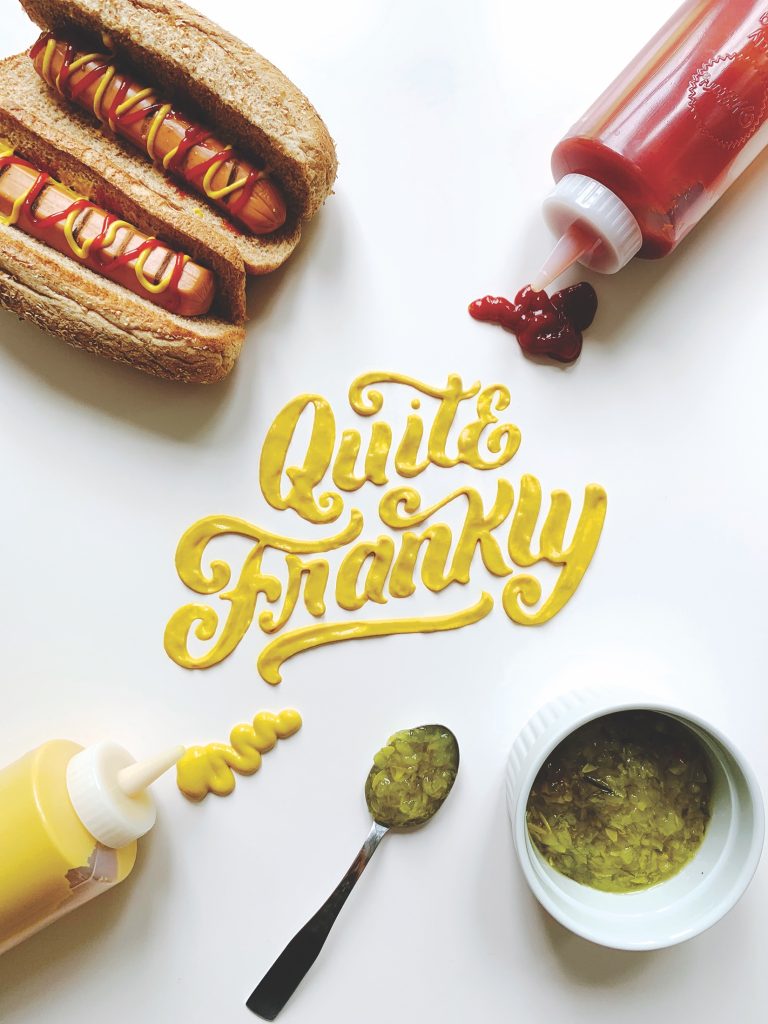
Mustard, spices, jam, cookie crumbs, sprinkles, honey, espresso powder, candy corn. Not necessarily ingredients you want in the same dish, but, for Marley Soden, they’re main ingredients in her recipe for creativity. On TikTok (marley.makes.things), where she dishes out a vibrant and colorful feast for the eyes, she describes herself as a “Letterer, Muralist, & Food Artist.” Sometimes sweet, sometimes nutty and sometimes spicy, this tactile artist has got something to say.

Scrolling through her posts, you’ll spy a lemon meringue tart on a bright-yellow backdrop with a whisk and lemons, the words “Easy Peasy” spelled out in meringue plus lemon curd accents. Or picture a breakfast scene, complete with golden bagels, a dusting of flour, an open tub of cream cheese and a smeared butter knife with the words “You Are My” written in flour. Then, to one side, the word “Everything” is spelled (and spills) out from a jar of Trader Joe’s Everything But the Bagel Sesame Seasoning Blend. And that’s just a small sampling to whet the appetite.

Has she always played with food? “Growing up, I was artsy, for sure,” says the 31-year-old Greensboro native. “But in middle school and high school, I was more into the music scene.” In fact, Soden graduated from downtown’s Weaver Academy in 2012, where she focused on music production. But, when she arrived at UNCG as a freshman, she wasn’t sure what she wanted to study. She hopped from English major to media studies major, but still felt unsettled.

On a whim, Soden made a leap into design. “I didn’t think it through whatsoever. And, thank God, it just kind of worked out and I really liked it.” The design aspect, however, came much later in her studies — after drawing, sculpting and other “really basic bare-bones stuff.” Little by little, she discovered she had a real love and knack for lettering, a small niche in the graphic design world.

After graduating in 2016 with a Bachelor of Fine Arts in New Media and Design, Soden was hired as a graphic designer locally for Pace Communications. She discovered that she was not made for office life, but, she says, she’s “so, so grateful for those years because it taught me so much about how to work with companies and how social media in general works.” After freelancing a bit on the side, she decided to bet on herself, going all-in on being self-employed.

Soden anticipated more freelance branding work, and that’s exactly what she did during that first year on her own. In the meantime, she’d post her creative work on Instagram. And, in December 2019, she posted her first video to TikTok, which, at the time, allowed a little bit of a longer video format than Instagram. In 2020, thanks to COVID, which found more and more people engaging with others through social media, TikTok really exploded on to the scene. “I just happened to be in the right place at the right time,” says Soden, “and a lot of my art videos took off.”

The result? “I pivoted from doing branding and logo design to doing more DIY content and educational art content online.” Think YouTube tutorials, but shorter. “I’m just not great at long-form content. Short form is where I really hit my stride and I’m great at telling stories quickly.” Which, it seems, is not something everyone can do as well as she does. And something increasingly in demand. The proof is in the pudding: Almost 550,000 followers agree, eating her content right up. Plus, Soden notes, as an introvert, finding community online suited her just fine — she found unexpected joy in teaching. “In a perfect world, that’s what I’ll do forever,” she muses.

While most of her social media following is similarly aged to Soden, she says those who actually engage with her on her posts are often Boomers. “I love those people for it. Yes, always comment because it makes my day,” she quips with a grin.

As for Gen Z? The word “depersonalization” is what comes to mind in describing their interactions on her posts. “When they do comment, they’re not commenting to me. They’re commenting to other commenters.” Instead of talking to Soden, “They’ll talk about ‘her.’ And I’m like, ‘Her?’ Me?”

Nonetheless, her vibrant, eye-catching and whimsical posts get people talking. This English-major-turned-design-major puts her love for wordplay to use regularly. “The fun thing about lettering in general is that you can really inject your personality into it, and you can quite literally say what you want to say through it, through your art.” A favorite video of her own features “Pop It Like It’s Hot,” the first two words spelled in popcorn kernels and the last word in spicy seasoning. And, of course, the song it’s paired with: Snoop Dogg’s “Drop It Like It’s Hot.” To celebrate the one year mark of being self-employed, she spelled out “one” in rainbow sprinkles.

“I won’t pretend to have invented it,” says Soden of food lettering. Detroit-based illustrator Lauren Hom (Hom Sweet Hom) served as big inspiration for her from the beginning, but, Soden notes, “from there, my style just took on a life of its own.”

Thanks to Soden’s instinctive talent for connecting with her social media audience through creating quirky, whimsical art, brand deals started rolling in. She’s worked with companies such as Owala, Adobe, Michaels Stores, Café Appliances, Shake Shack, Digiornio, Russell Stover and Aerie. On her wish list? Twizzlers, Starburst or Skittles. “Anything that’s really bright and colorful and interesting texturally would be fun.”

Even though brand deals provide her with income, it’s the making — and teaching how to make — art that fills her cup. For instance, Soden brought many of her passions together in one project when she created an entire series based on podcasts — “I love food, and I love music, and I love podcasts.” For Armchair Expert, cherries and pistachios were used to create a story, with crushed pistachios spelling out the title. In that Instagram post, Soden writes that she chose cherry because: “get it? chairy?” In another post, Conan O’Brien Needs a Friend is written in apricot preserves and surrounded by scattering of almonds as well as apricot-and-almond buns (“because that hair is iconic”) and almonds.

Liquid, she notes, is especially hard to work with but produces a silky look she can’t get enough of. “The letters want to morph together,” notes Soden, so time is of the essence. And, the moment you start a project with any kind of liquid or sticky food, there’s no going back. “Once it’s down, it’s down for sure. Ask my countertops.”

To cut down on waste, every work of tactile art she creates has to have a meticulous plan, beginning with a sketch. Or, if she’s working with a client, a series of sketches. That’s followed by making stencils and, lastly, she’s ready to move on to making — and shooting — the final product. The outcome generally reflects her signature style, which she refers to as “organized chaos.”

In the end, from a creative arrangement of plates and “things toppled over,” order arises, with artist-to-the-beholder communication emerging.

Is it something AI could reproduce? Maybe, but Soden notes that there’s something lacking in AI. Sure, these days “it’s looking more and more realistic. Realistic isn’t necessarily good. I’m still missing that little piece of soul within it that you can’t really get from anything other than a real person.”

Any artist, of course, loves to explore on various mediums, from digitally in iPad screens all the way to broad-brush work on walls. You just may have spied Soden’s Mural work locally in Local Honey Salon, the former Borough Market & Bar, King’s BBQ in Archdale, Lash & Blade in Winston-Salem and Inkvictus Studios in Raleigh.

In fact, Soden’s most popular TikTok video, viewed 7.2 million times and growing, has nothing to do with lettering. Instead, in under one minute, she teaches viewers how to paint the perfect arch on their wall, ending by telling them, “Follow me for more artsy-fartsy stuff.”

Over the past six years as she’s experienced explosive growth on social media, the platforms themselves have evolved and changed. TikTok, for example, now allows for 10-minute videos. Plus, the algorithm itself changes constantly, treating its content creators to a virtual roller coaster ride. One day, your video could garner 100,000 views. The next, 3,000. “You just have to ride the wave and keep putting stuff out.”

Soden’s life behind the grid has changed, too. In 2021, she married Zach Hunt, a logistics analytics manager for Ralph Lauren, and, a couple years later, they welcomed a son. Soden anticipated that after just a short time off, she’d be working at home, baby by her side. “I had this naive idea in my head that I’m a freelancer, I can do both,” she muses. “I can watch my kid and, while he’s sleeping, then I’ll do some work.” Turns out, juggling that schedule “on top of just healing in general, learning to be a mom and having a serious sleep deprivation” was utterly exhausting. Soden found herself backing off work.

“The thing that people don’t think about when women take time off for maternity leave is that you’re not only sacrificing your income,” says Soden, “but you’re sacrificing that time that you would have spent advancing in your career.” Plus, being home with a baby and away from colleagues can, as any parent who has done it could tell you, feel lonely. After their son’s first birthday, she and Zach made the decision to put him in daycare so that she could have the time “to work and continue exploring.” Still, some days, she asks herself, “Am I doing the right thing?”

Parenting aside, stepping back onto the career path comes with its own challenges. “While you’ve pressed the pause button, you come back and everything is different,” she says. “The real world doesn’t wait for you.”

Indeed, there were no new freelance jobs, she admits, waiting for her to once again press play. So, even though Soden is adept, brilliant actually, at communicating via social media, she’s changing her approach, focusing on growing her business locally, weaving herself into Greensboro’s cultural fabric. Still, she says, “I would love to continue in social media in some way without it being my primary source of income.” The next step? Perhaps selling her art — from prints to possibly even coloring books — locally. “In general, I think people are seeking community right now because we’re all so isolated,” she says. A local presence just might be what helps her expand her net of communication, but her hope is she can regain a healthy foothold in social media once again.

On her plate currently, she’s scheming and dreaming about a just-for-fun Harry Styles-themed piece based on the song “Golden” and inspired by her toddler. “My son is his number one fan.” So far, her plans include “golden pancakes and golden syrup spelling out ‘You’re so golden’ on a big, yellow background.”

Artist. Foodie. Muralist. Letterer. It’s obvious that Soden’s creative juices will keep on spilling and spelling out — onto pancakes, onto screens, onto paper, onto walls and into the hungry hearts and minds of her community. 

The Preservationist and the Painter

THE PRESERVATIONIST AND THE PAINTER

The Preservationist and the Painter

A marriage of opposites dances in the light on Magnolia

By Cynthia Adams

Photographs by John gessner

Preservationist Mike Cowhig was a longtime bachelor in his 50s living on Eugene Street in a Craftsman-style home when he met his wife, artist Denise Landi. He worked excessively, golfed occasionally and sometimes, she jokes, “held up the wall” at the original Rhino Club downtown, which recently reopened.

Formerly married with two young girls and a boy, Landi studied art history at Carolina. Over a 40-year career, she has dramatically incorporated her personal history, memories and fragments of dreams into paintings.

Art was a consuming passion for her; community planning, history and preservation were his.

The couple dated for two years before deciding to marry but were torn between her recently acquired house on Magnolia and Cowhig’s bachelor bungalow.

Magnolia Street won. His impression when he first toured the house? Smitten.

“I love this house,” admits Cowhig, a longtime community planner for the City of Greensboro.   

“I’m glad we decided here,” he adds, “although I loved the house on Eugene.”

They were married in the backyard of the house in 2004, a year after Landi purchased the Colonial Revival. Neighbor Nicole Crews hosted a wedding reception, and the celebration continued afterward at local hangout Fishers Grille. (A gate in her back fence, Cowhig explains, then conveniently opened to the backside of the bar.) 

The wedding party and guests merrily trooped through the house, out the gate and into Fishers, he remembers. The bride hired a new local band called Beaconwood for the occasion.

“Beaconwood played bluegrass and other types of music and were fantastic!” Cowhig adds. Fast forward 15 years after their raucous musical wedding party at Fishers Grille. 

“Steve Robertson, a local attorney, moved into a house on Leftwich Street very close by,” says Cowhig. His son Eric Robertson founded Beaconwood while in high school. Their members now played on a world stage with artists like Rhiannon Giddens and Steve Martin.

If Beaconwood set the tone for a mellow relationship, not every note played smoothly in the early phases of marriage. Initially, while planning an addition to the rear of the two-story clapboard back on Magnolia, the new family of five squeezed into Cowhig’s bachelor pad at 923 N. Eugene St., the three young children “bunking in one room.” It was a madcap jumble of Barbies and G. I. Joes. Landi’s youngest daughter was still a toddler.

“I think he fell in love with my kids. And he liked me, too, you know?” Landi says with a twinkle.

“Our contractor did that thing where they get close to completion and then they move on,” Cowhig recalls. “Denise read them the Riot Act. I was glad — she had every right. She let them know she was not happy.” After that, the addition came together.

Cowhig was naturally interested in the particulars, being a walking compendium of Greensboro’s original neighborhoods. Living in Fisher Park, designated as a historic district in 1982, was a form of work immersion for Cowhig. 

Early in his professional life, he assisted in gathering supportive evidence for the district, inventorying the neighborhood’s original layout and structures. Cowhig worked on the creation of Greensboro’s three historic districts, now including Dunleath and College Hill.

Consider the context: When the Schoonover house was built, Fisher Park was evolving as Greensboro’s first suburb, featuring a variety of architectural styles and opulent mansions on a section of North Elm Street dubbed the “gold coast.” Iconic churches nearby — Holy Trinity Episcopal (built in 1922), the imposing gothic First Presbyterian (built in 1928) and Temple Emanuel (built in 1922) — all sprang up in that period.

But even an expert can be thrown off by clues contained within an old house. Just how old was it?

He discovered a piece of children’s homework dated 1912 “so I assumed it was built around 1911–12.” But further research placed the house as being built later, in 1921, for physician Robert A. Schoonover. So much for circumstantial evidence. The doctor kept an office nearby on South Elm Street, mentioned in the 1925 edition of Hill’s Greensboro Directory.

As pleasant as the attributes of a century-old home may be — nicely sized rooms, original windows and two working fireplaces — the historic record matters less than evidence of a family thriving here.

Their children’s heights are not just marked but colorfully illustrated (by the hand of a painter mother) inside a doorway into the kitchen. Cowhig and Landi planted roots in a neighborhood, not merely a house. A walkable, convivial area where neighbors know their neighbors. 

Fred Rogers would have been pleased.

Whereas Cowhig is a man of measured speech and action, the woman of the house is a dynamo of color and vitality. 

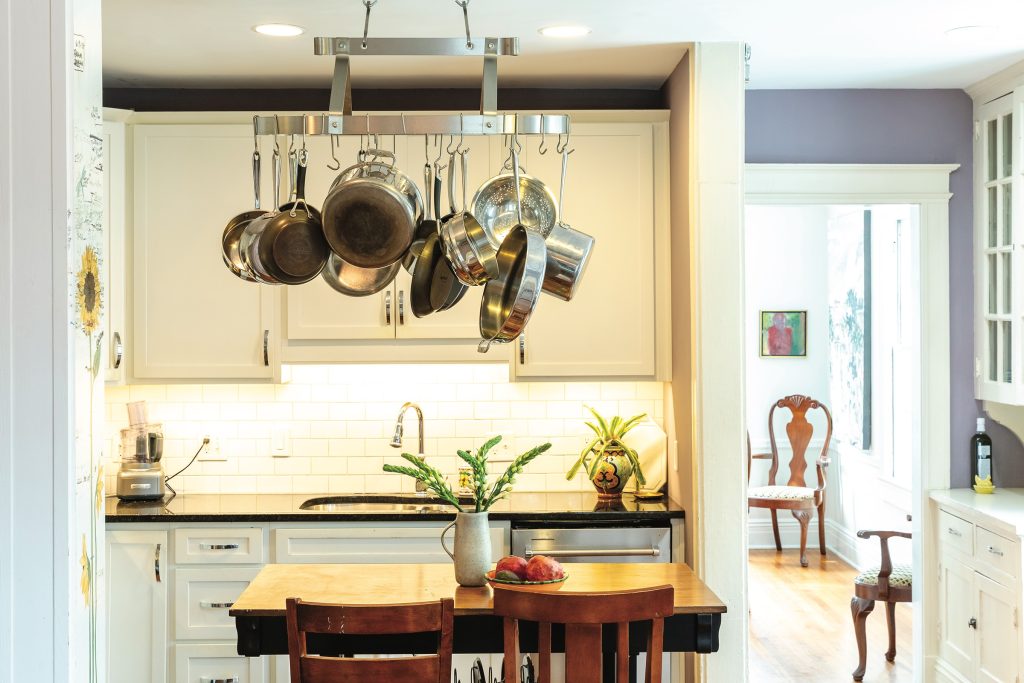
She laces a hot coffee with creamer and immediately takes a bold drink — no cautious sipping first. Landi bristles with energy even without caffeine but pauses long enough to enjoy her coffee in a kitchen shot full of life and light. An adjacent butler’s pantry with original cabinetry creates a conduit to the dining room. 

As you might expect in the home of an artist, furnishings and clutter are deliberately edited to allow artwork to take center stage.

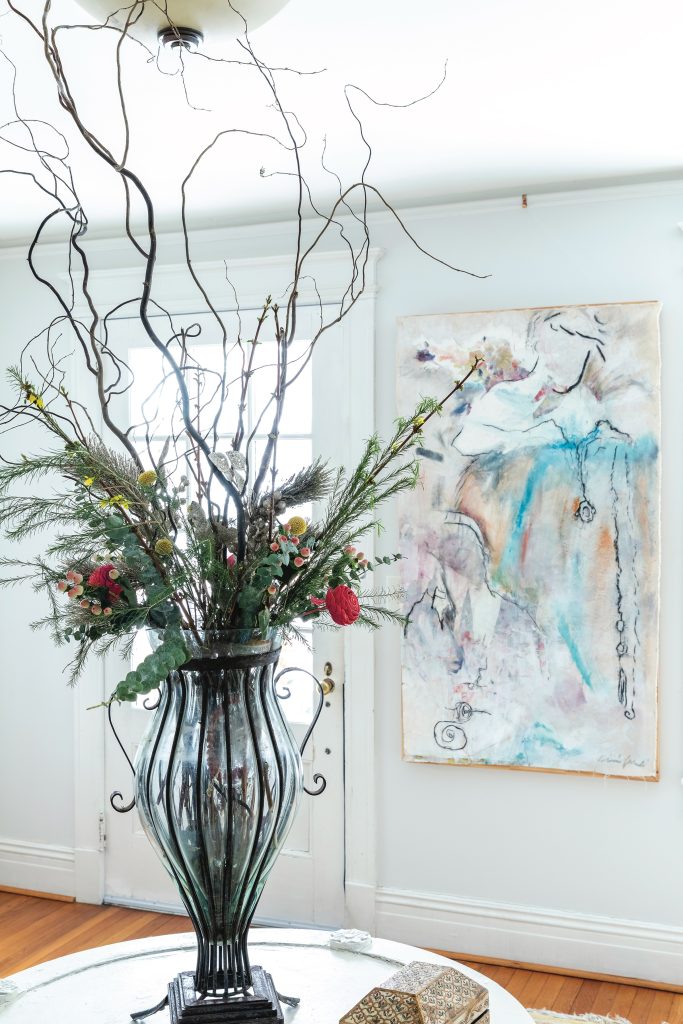
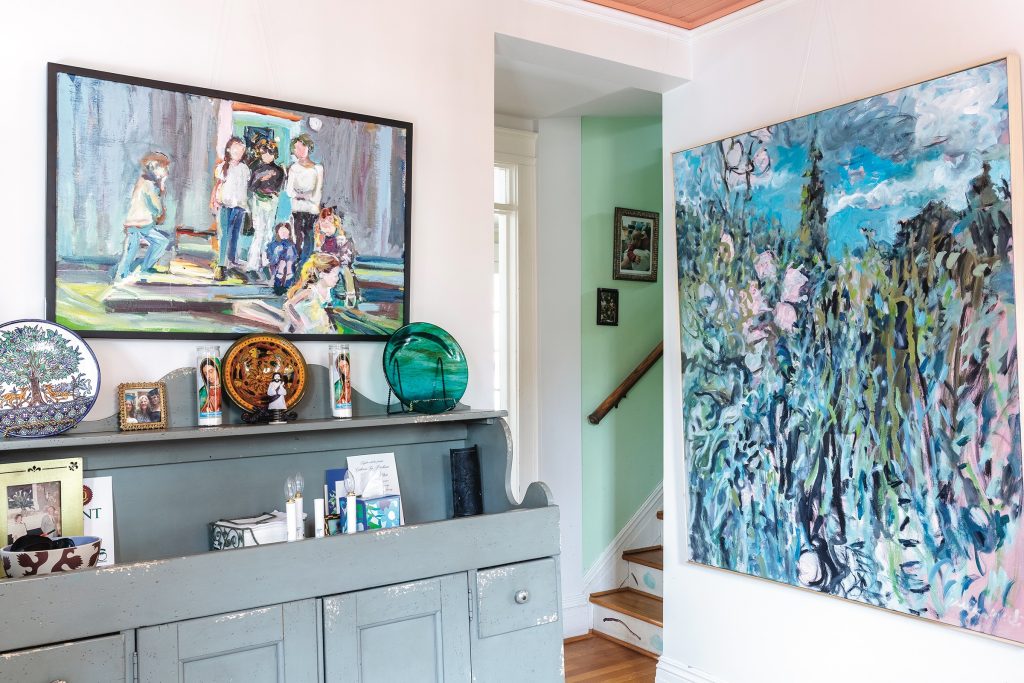
Generous molding, handsome mantels, built-in bookcases (which they supplemented with more during the building of the addition) and French doors separating the living room, den and the dining room up the charm factor. With ample wall space painted in pale tones, Landi’s art serves as the chief source of color — she is a prodigious artist who sometimes produces multiple works in a single week. Their home is a perfect showcase for it.

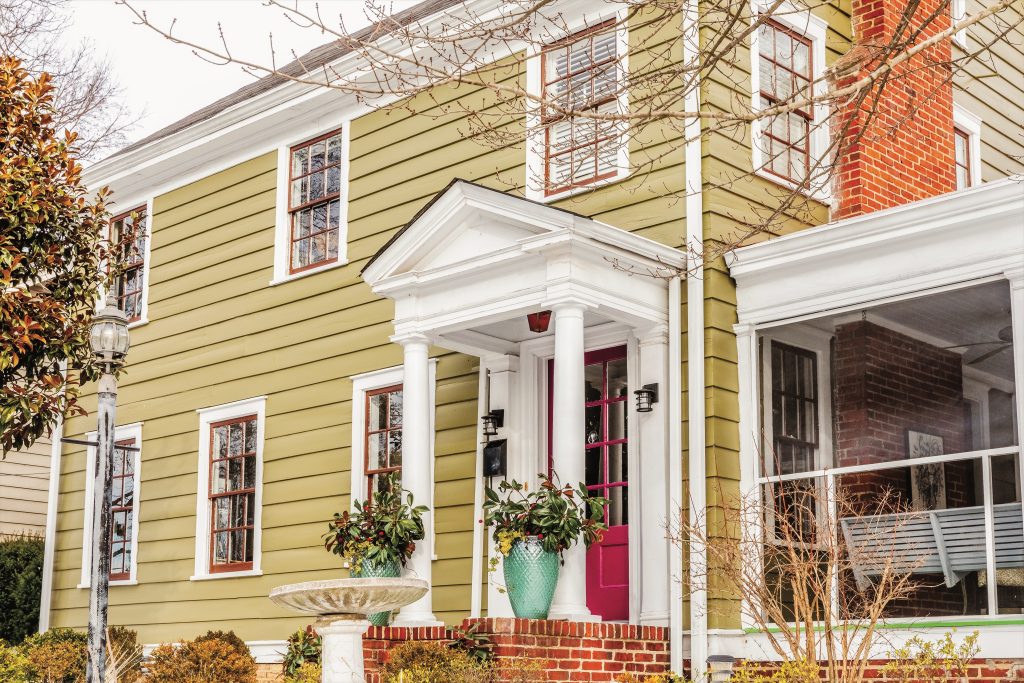
After ridding the house of aluminum siding long ago, its original, albeit in need of a refresh, beauty emerged.

Tax credits were instrumental in being able to afford a historically accurate rehabilitation: “We used North Carolina historic tax credits, which was 30% at that time,” Cowhig recalls. “That credit really made the difference for us.” Once the siding was banished, Landi chose new exterior colors, bolder than the original white found beneath the siding. 

“It’s a house that was built without a front portico, [but] which has a nice classical roof and columns, and a nice, screened side porch,” Cowhig says.

Landi again mentions that every room has good light, something deeply valued by one whose work depends upon it. 

Given her artistic focus, it is surprising that it was not her original career plan. “I was going to Carolina intending to become a journalist” before that notion ground to a halt once there. “I couldn’t type,” she says with a rueful shake of her head.

“I never learned to type!” she repeats with incredulity. Her mother, who studied fashion at Parsons School of Design in New York, strongly discouraged her daughter from wasting time on pedestrian skills. 

Landi changed her major to art history. Following her degree, she began seriously studying painting. She completed an M.F.A. in Florence, Italy, at the Dominican University, devoting two years to the Italian Renaissance. 

Initially, the idea of becoming an artist seemed “just too easy.” 

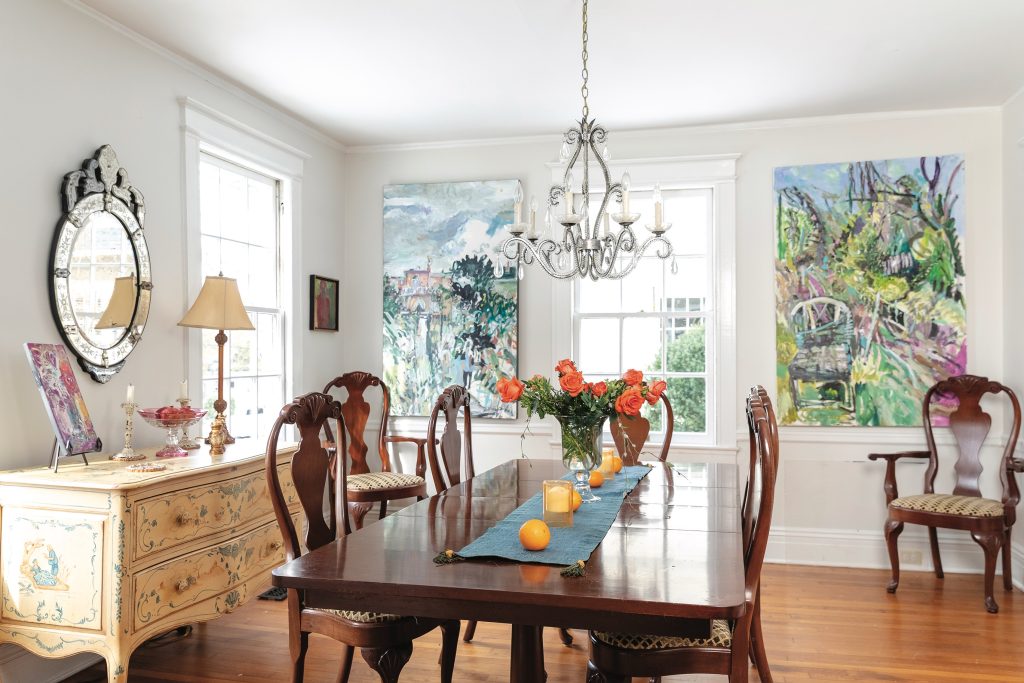
“My very first words were ‘pretty light.’ I did not say mama, hi, daddy, anything. And it was at my grandmother’s chandelier,” says Landi. No coincidence, then, that her first show at The Marshall Muse Gallery this year was titled “Categories of Light”. 

Landi’s largest work there? Chandelier (Southern Lights).

The inspiration for that painting is the dining room’s Italian chandelier, which features a light-refracting, antique, Venetian mirror found at Carriage House.

On the same brusque, wintry morning that Landi meets to discuss the house, Cowhig pops over to his old office in City Hall where he began working in 1975. He is technically retired yet still putting in a few hours weekly with a South Benbow project. In fact, he shared recognition with two others for a Voices of the City Award last November for contributions to that work. 

Bert VanderVeen, a volunteer member of the Historic Preservation Commission, or HPC, first met Cowhig 25 years ago.

“What do you say about Mike, who is and does so much?” asks VanderVeen. “One of my first calls in 2001 was to the city planning department when I bought a historic house in Dunleath and needed a COA [certificate of appropriateness] to make repairs.”

VanderVeen has seen firsthand how Cowhig works tirelessly to bring about preservation, as in the case of the newly developing South Benbow district, the first of its designation in the state. “He can shepherd you to a solution. One thing that struck me on the commission was that even when we did not agree completely, Mike would get us there.”

When historic buildings could not be saved, Cowhig advocated for an architectural salvage program benefiting Blandwood, the historic Governor Moorehead mansion. He rallied and worked alongside volunteers to salvage slate tiles from my own Latham Park home a few years ago.

His retirement is keenly felt.

“I really miss working with Mike both on the Greensboro commission and at Architectural Salvage [ASG],” says Commissioner Katherine Rowe, who lives in Sunset Hills. “Salvage volunteers felt lucky to learn from Mike. He has a deep knowledge of Greensboro’s history and neighborhoods.” 

She fondly remembers doing pickups with Mike. “We’d rumble around town in the rattly Architectural Salvage van, picking up six-panel doors in Fisher Park or prying out house parts in an abandoned home way out in the country,” she recalls. “We’d gather doorknobs and butterfly hinges to sell back at ASG.” 

He recruited Landi to help with a pickup in his absence. “To her credit, Denise very cheerfully helped me load it in the white van,” says Rowe. “We had never even met!”

“I love history just as much as he does,” Landi adds. “And houses.”

Her aunt lived in a Tarboro antebellum house, one Landi stayed in and admired. She also visited her godparent in Toronto during the summer, whose grand home was furnished with antiques. She mentions granular details right down to the home’s fine marble doorknobs. 

Her husband is “a man whose life has been about helping save old houses,” she notes. “I love the way Mike . . .” Landi stops, searching for the right phrase. Then she brushes the air with her hand. 

“OK, here is the problem. In the same way that we love them spiritually, sometimes we forget to love them physically.” 

She adds meaningfully, “I can be messy.”

Placing her coffee cup on the kitchen table, Landi gesticulates, trying to describe their relationship. Her father was Italian, she explains, so she requires both hands when passionate. 

She borrows a visual from something she read of a slow-moving person holding a balloon which pulls him along. “And that’s kind of like me and Mike. Mike keeps me from flying off too far. I can see that.”

Her expressive face opens with a smile. She, in turn, helps to prevent her husband, a quietly sanguine man, from being overly cautious. Even if she might veer and “pull him over the rocks.”

“She’s the real deal when it comes to her artwork,” he says about his wife. “The painting, the artwork is what gives her energy. She will wake up, cannot sleep, and she gets up and starts painting.” The next morning, he finds she has created something remarkable. 

Landi spontaneously offers a full tour while searching for a misplaced phone. Wherever the eye lands, there is a point of beauty: a vintage Empire-style dress she recently wore to a Jane Austen birthday celebration hanging in a bedroom, an antique Italian tile hung on the wall like an icon. 

“Actually, it is an icon,” she decides.

She scans the foyer, elegantly spare with a center painted table, leading to the side porch where she often works.

When painting outside, she says, “I feel expanded and unfettered. I sometimes put paintings on the fence and go at it.”

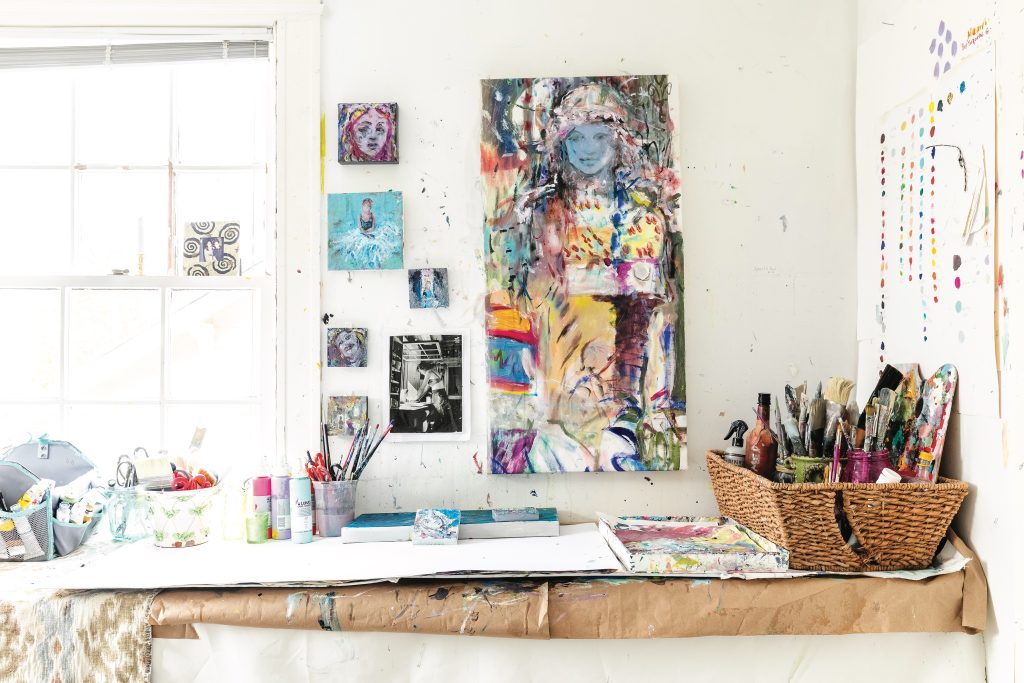
Landi then weaves through private rooms downstairs, to the addition at the back, which created office space, bathrooms and bedrooms. Looping back into the original portion of the house, she proceeds upstairs to the bedrooms where she reclaimed a vacated bedroom as a studio.

Scribbled notes and elaborate, artful doodles paper the studio walls. 

“This was my son’s room for a long time,” she explains. Her visual process involves prompts from writing, she explains.

“I write a lot and also write things on the wall.” She traces notes made, recalling the vagaries of mind and process.

There is a striking variety of visual approaches: sometimes pastel, ghostly abstractions, sometimes vividly bold black-and-white charcoals. Some of the large-scale, acrylic paintings hung throughout the hallways and rooms of the house are already sold and awaiting shipment.

Landi has shown at the GreenHill Center for NC Art and the Center for Visual Artists. Her figurative paintings hang in permanent collections at Moses Cone Hospital, Schiffman’s Jewelers and Blue Denim restaurant.

Her work has common denominators, she stresses: light and spirit. 

Larry Richardson, a family friend for decades, speaks to this. 

“Denise does not see the world as you or I do,” he says. “She sees things in spiritual terms.” He describes how her work is sometimes overtly feminine, or dark and masculine.

“She isn’t just painting what she sees,” he explains. “She paints the energy.” 

Florence opened Landi’s eyes to a new way of seeing and working. It was, she says, spiritual. “When I would paint scenes, I would paint spirits.”

“There was a small river, and I saw the whole town (of Florence) as a heart. And then I saw that river as . . . this artery.”

Phone found, she returns to the kitchen and produces a vintage family portrait. Her Italian father, with Mediterranean coloring and effusive, ebullient personality, is a contrast to her mother, a serene, ladylike blonde with pale eyes. A woman of great composure.

“Isn’t she beautiful?” she asks. “Like Grace Kelly. A classic, Hitchcock beauty.” 

There is no mistaking that Landi’s parents’ union, like her own, was a marriage of complementary opposites.

Cowhig will be home at any time, she expects. He is happiest, Landi notes, when holding the new grandbaby, Wolfie, soon to be a year old.

He is delighted when grandchildren visit, calling out “Michael!” and heading straight to his office, where they find him keeping a hand in historic projects. By his reckoning, Greensboro’s oldest structures are art of a different kind.

She rests the family picture against a colorful, flower-filled pottery vase by a dish of lemons on the rustic table. An instant composition. 

One worthy of her hand

O.Henry Ending

O.HENRY ENDING

Please Pass the Salt

Tickled pink, but feeling blue

By David Theall

Bad news in my email just now: “FINAL NOTICE: Your Discount on the Pink Salt Weight Loss Solution Expires Today.” Unless I can come up with $79 fast, all of my friends are going to be posting about the great deal they got on Pink Salt Weight Loss Solution and I’ll be the unlucky loser, relegated to plain-old white salt, no weight loss solution in sight.

With my customary Mountain Dew in hand I’m compelled to learn more. What is pink salt and how do I get this miracle weight loss solution? Knowing that sometimes there can be unsavory operatives in the weight loss industry, it’s a relief to see that the email came from Diet Science Review, an organization that likely rivals The New England Journal of Medicine in addressing critical emerging topics in modern medicine.

I then make the dream-crushing mistake of using the web to learn more about the Review. From the AI feature on Google: “As of October 2025, there is no major publication titled ‘Diet Science Review.’ The name appears to be used in some blogs and for book promotions, rather than representing a formal scientific source.”

Damn! My dream is not completely crushed, however, because the email also mentions Harvard researchers . . . more than once! “Harvard Researchers Shocked: Women Are Using This ‘Pink Salt Hack’ to Drop 20 Pounds Without Giving Up Burgers or Wine.” That stops me, dead in my tracks. I don’t want to give up burgers or wine, sure, but the Harvard researchers only mention women. Is the Pink Salt Weight Loss Solution gender specific?
I guess that’s it for this guy. No miracle pink salt for me. I can’t target my arm, belly and thigh fat while continuing to decimate area buffets. I visit the website link in the email to see if there’s a male version, but find this statement instead: “Some reviews or testimonials may be fictitious.” So, I’m starting to think all this “miracle weight loss” talk should be taken with a grain of salt (pink salt, to be specific).

Honestly, this whole weight loss business is new to me. Is it common for these products to be gender specific? Does the whole internet think I’m an overweight woman? Should I try to find a Blue Salt Weight Loss Solution?

More bad news. After checking online, I learn there’s no male alternative for the pink salt hack. Digging further, I discover that there is no such thing as blue salt either. With no way to redress this senseless gender inequality, maybe I’ll just go out and discover blue Himalayan salt for my own self, even if it means bringing food dye to find it.

Then, using retired meth lab equipment purchased at a New Mexico police auction, I’ll cook up a formula for Dave’s Famous Himalayan Blue Salt Weight Loss Solution. We’ll keep production cost low and sell it for $59 per half-ounce bottle. We’ll hire Zach Galifianakis or Jack Black to post on socials and — bingo! — I get to retire rich, relinquishing all concern for my public appearance as well as basic daily hygiene.

No weight loss, no problem! 

Any Way You Slice It

ANY WAY YOU SLICE IT

Any Way You Slice It

Pi Day, you say? We couldn’t think of a better way to celebrate than by stuffing ourselves silly with a local sampling.

By David Claude Bailey     Photographs by Amy Freeman

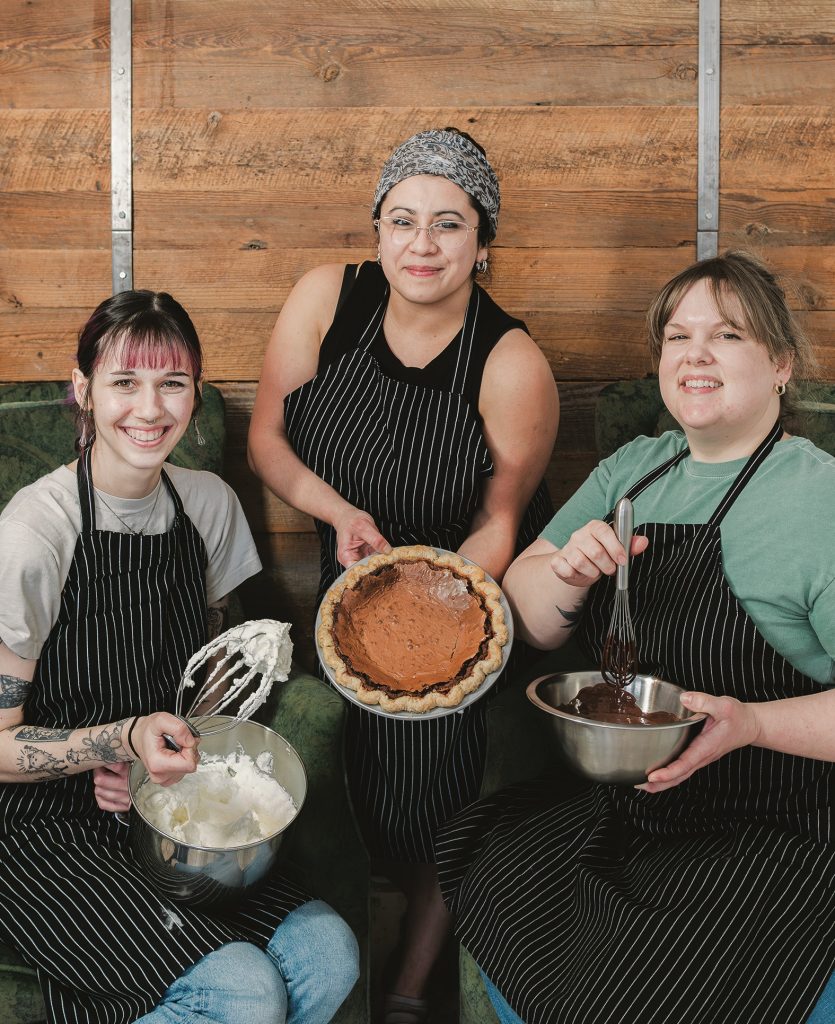
What is it about pies? “I suspect that people feel a sense of tradition and simple goodness when eating pie,” says Maxie B’s owner, Robin Davis, who was featured in a 2012 Southern Living best-cakes-in-the-South article. Robin also knows a little something about pies. Chocolate chess, pecan, coconut custard, coconut cream, chocolate cream, lemon meringue, cherry, blueberry, peach, blackberry, sweet potato, pumpkin — 40 in all, seasonally available. “They are a little lighter than cake since they do not have icing.” Almost healthy, eh?

And then she adds, “Mostly, I think eating pie is just a comforting experience.”

Amen.

Robin is just one of a wealth of seasoned pie-o-neers who have made Greensboro, at least in our view, pie central.

Grab a fork and dig into one of my own favorite comfort foods. We know we’ve missed some of our favorites and your favorites, but there are only so many notches in our belt and these six slices were pushing its limit.

THE PIE HOLE: Maxie B’s

If you’re not able to visit a pâtisserie any time soon, Maxie B’s interior comes pretty close to transporting you à Paris. How many other bakeries feature chandeliers, tufted banquettes, plump, comfy couches and a private, hideaway booth for intimate gatherings? Or, naturellement, snag a seat at the sidewalk café in front and order a café au lait and, of course, a piece of good ol’ American pie.

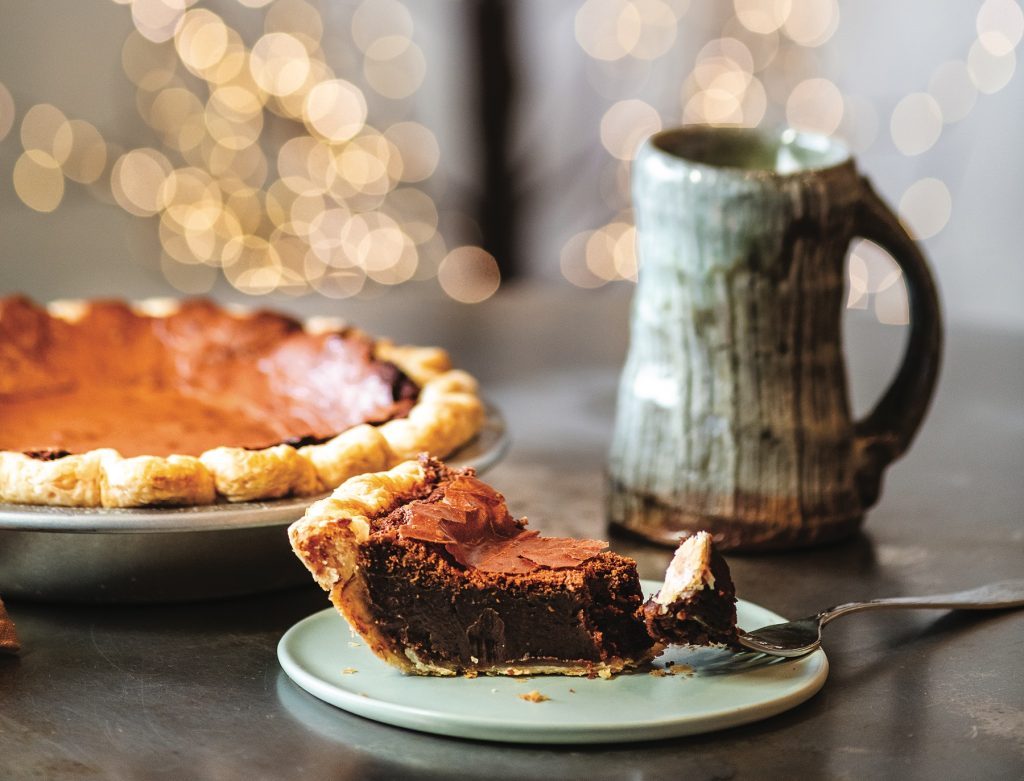
THE PIE: Chocolate chess

THE LOWDOWN: While the butter in the hand-made, rolled-daily crust hails from Europe, not to worry: the pastry flour is from North Carolina. The only other ingredients are a little sugar, some salt, some vinegar, ice water and TLC. The filling ingredients are equally simple — Swiss chocolate, butter, local cage-free eggs, vanilla, sugar and salt. The cacao beans? From Ghana.

MY TAKEAWAY: Forget Frenchified soufflé au chocolat or chocolate mousse. Sit down to a Southern favorite that dates back to Martha Washington — chess pie. This version is intense, dominated by a jolt of chocolate that dances all over your tongue. The crust is textbook, so rich and flaky you look forward to attacking what’s sometimes left uneaten on other pies — the crust’s shoulder.

MOST POPULAR PIE: Chocolate chess, of course

THE PIE MAKER: Robin Davis, the owner of Maxie B’s (named after pugs Max and Bitterman), never meant to run a cake shop. It was her late husband, Lewis, a workout fanatic, who in 2002 urged her to, please, stop filling the house and kitchen with tempting cakes. So she moved her baking operation to the yogurt shop she was running. While pregnant, she craved a devil’s food cake like the ones she remembered from family reunions. The rest, like our slice of her pie, is history. Two articles in Southern Living brought, quite literally, busloads of people to try this devil’s (and angel) food, and, as business boomed, Robin’s shop expanded, gobbling up two adjacent storefronts. The devil’s food cake is still available, along with red velvet, hummingbird, coconut, caramel and dozens of others.

THE INSIDE SCOOP: Pies featured year-round include chocolate chess, pecan, coconut custard (and cream) and chocolate cream. Seasonally, expect lemon meringue and cherry, plus, when available, fruit pies with local, freshly picked produce, including blackberry pies (stuffed with Climax Creek Homestead berries) and sweet potato pies (with taters from Faucette Farms in Brown Summit).

2403 Battleground Ave., Greensboro
336-288-9811, maxieb.com

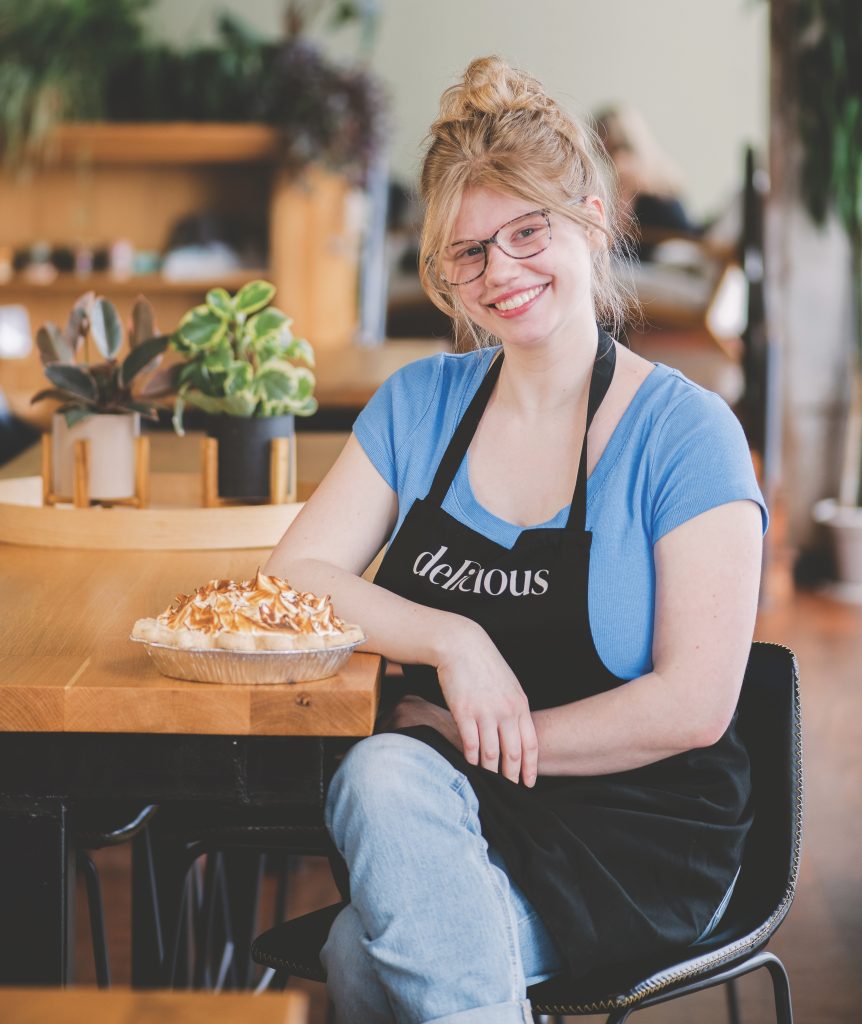
THE PIE HOLE: Delicious Bakery

Sit down to your pie in Delicious’ new, light, bright and airy venue on Battleground. The dining area is spacious, affording privacy if you want to share the latest crumb of gossip (or pie) with a confidante. Or seek out a nook where you, your laptop and an espresso can get some work done — or eat as much pie as you want away from prying eyes.

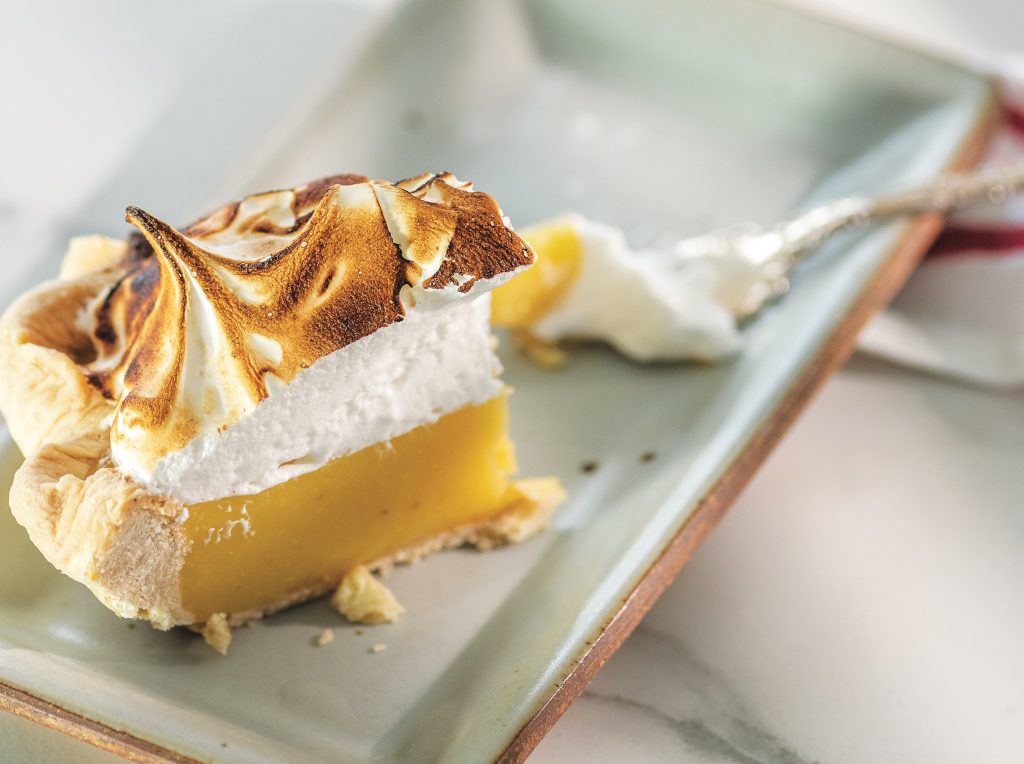
OUR SLICE: Lemon meringue

THE LOWDOWN: The crust is hand-rolled, butter-based and made from scratch. The filling, made from egg yolks, sugar, butter, lemon juice and zest, is thickened with corn starch. A stunning swirl of meringue made from egg whites, sugar and vanilla is torched to a golden brown finish.

MY TAKEAWAY: It seemed a shame to take a knife to the towering, mile-high meringue, but, when I did, the aroma of fresh-sliced lemons permeated the air. The filling bristled with a sweet-and-sour tang while the meringue provided a great
balance to its tartness, not too rich or sweet. The pre-baked crust served as a tasty vessel — and not over-baked. Here’s a dessert that’s a classic for a good reason.

BEST SELLER: Chocolate chess

THE PIE MAKERS: Owner Mary Reid, as much an artist as a baker, got things going in her home kitchen in 2004, whipping up and decorating cakes for neighbors and friends. She soon opened a storefront and then a sit-down location with Lori Loftis, her sister and a pie enthusiast, who has dipped her spoon in and out of the business for the last 20 years.

THE INSIDE SCOOP: As a full-service bakery with seasonal offerings including cakes, cupcakes, cheesecakes, cookies, brownies and breakfast pastries, it’s become a really popular meet-and-eat spot. My only battle in this space that once housed Burger Warfare is which pie to order.

1209 Battleground Ave., Greensboro
336-282-1377  |  336-288-3657  |  delicious-cakes.com

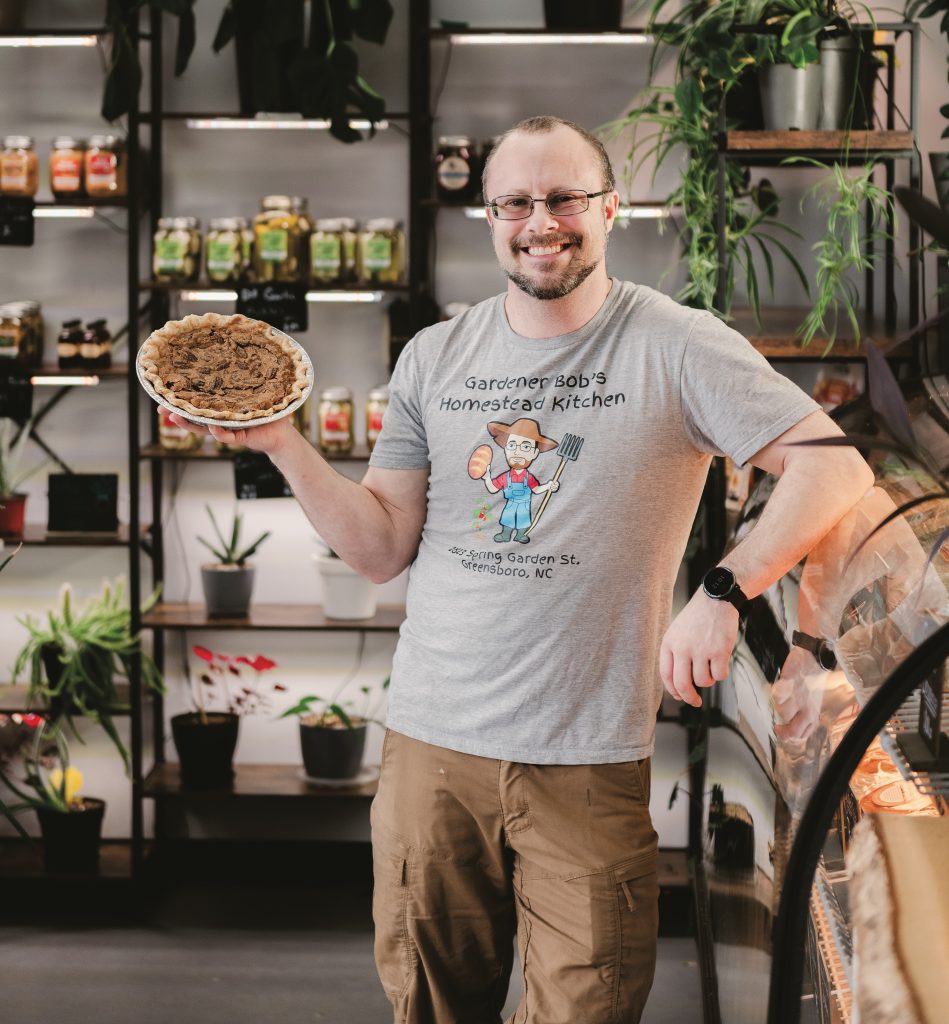
THE PIE HOLE: Gardener Bob Homestead Kitchen

A modest storefront with a few tables on the sidewalk out front, Bob’s spot has a sort of alternative, organic vibe, just like Gardener Bob.

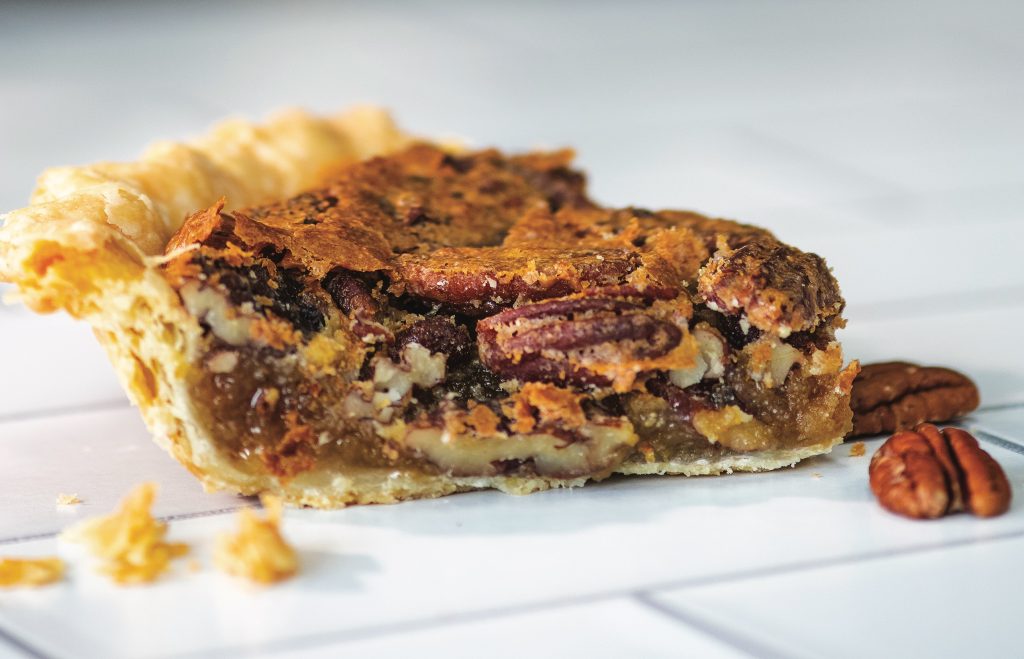
OUR SLICE: Pecan

THE LOWDOWN: The crust is homemade with King Arthur’s wheat-and-barley flour, water, salt and butter. The custard filling, baked in the pie, is a confection of sweet-cream butter, flour, evaporated milk and brown sugar — no high-fructose corn syrup. 

MY TAKEAWAY: A variant on your traditional Southern pecan pie, Bob’s version is a three-part harmony beginning with sort of a praline topping that crinkles up across the top and is good enough to pick off and eat like candy. The filling is a caramelly melody of pecans, butter and brown sugar with a grace note of vanilla. The fairly thin crust is a cracker sponge that I used to sop up the syrup that spilled across my pie plate.

BEST SELLER: Pecan

THE PIE MAKER: Working in kitchens since attending culinary school as a teen, Robert (please call him Bob) Thomas has cooked for a living all his life, including three years as a baker. He’s always had a soft spot for making desserts. Recovering from alcohol and heroin addiction at 33, Bob was surprised that he continued to be plagued by digestive issues. Determined to leave preservatives, dyes, chemicals, artificial ingredients and processed foods behind, Bob gardened, baked, fermented and cooked his way to better gut health. In 2021, he began selling his goods in farmers markets, along with his home-grown vegetables. He opened his Spring Garden storefront in November 2023.

THE INSIDE SCOOP: Determined to share his journey to good health with both advice and merch, Bob specializes in foods that promote good gut health — sourdough bread, all things fermented — from sauerkraut to pickles, kimchi to kombucha — along with baked goods (some gluten-free) and, of course, pies of every ilk.

2823 Spring Garden St., Greensboro
743-222-3933  |  gardenerbob.com

THE PIE HOLE: POUND by Legacy Cakes

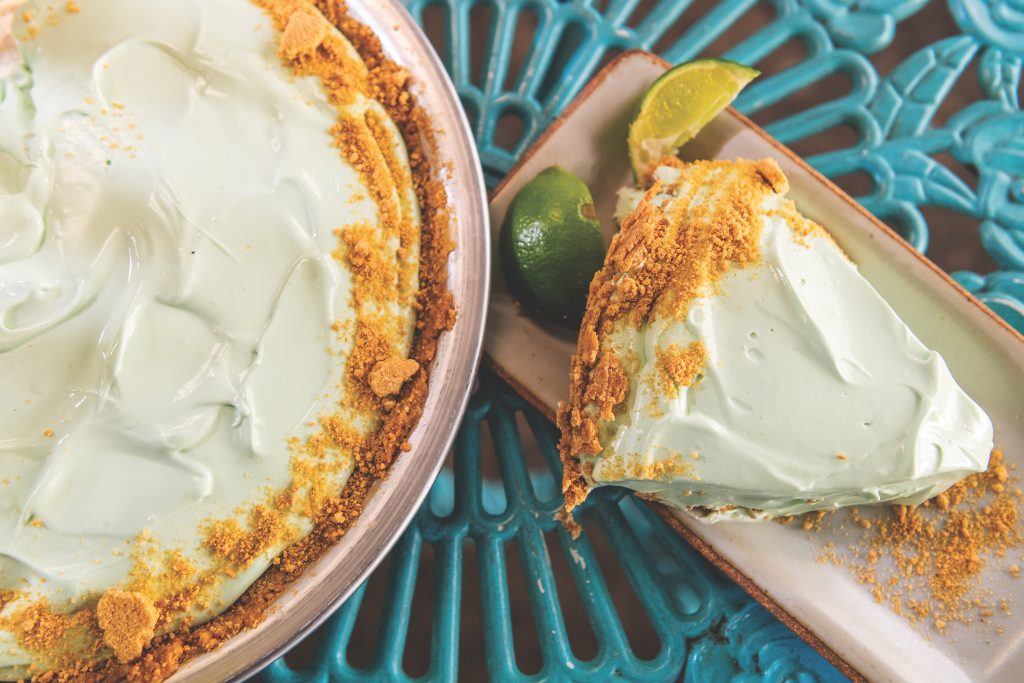
THE PIE: Key lime cream

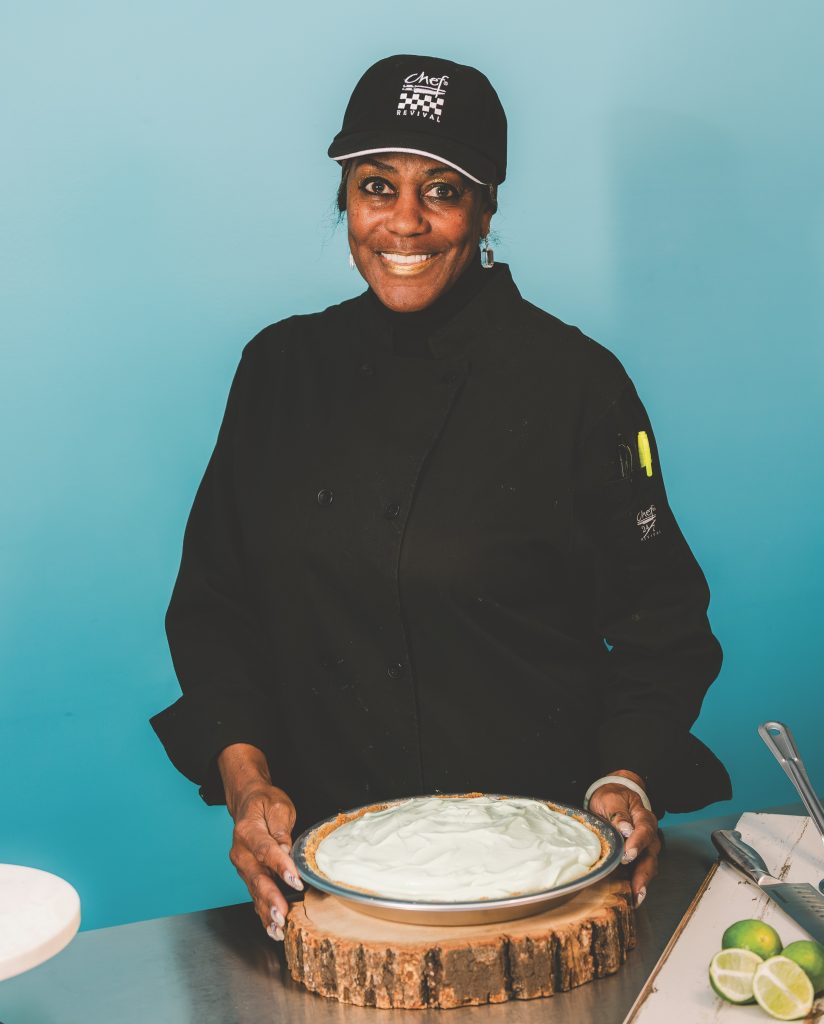
THE LOWDOWN: The recipe, passed down from her mother, Margaret S. Gladney, is a bit of a family secret, but Margaret Elaine, who is, of course, named after her mom, did reveal that it’s whipped, not cooked, and the filling involves sweetened condense milk. And she, naturally, uses those itty-bitty key limes, organic please.

MY TAKEAWAY: Unlike heavier key lime pie filling, cooked with egg yolks and condensed milk, Margaret’s filling is light and creamy, almost fluffy, with a subtle, not citrusy balance of sweet and sour. (It’s so good that, if left unattended on a table top, swipe marks from family fingers inevitably appear!) Playing against the tart filling, the golden graham-cracker crust is a neutral palate with scrumptious, crunchy crumbles around the pie’s edge.

MOST POPULAR PIE: Key lime cream

THE PIE MAKER: Margaret says her Key lime pie is a spin-off of the one her mother would make, along with the famous lemon pound cake her mom baked for revivals at the 120-year-old Goshen United Methodist Church. As the youngest of 13 children, Margaret recalls her momma telling her to tiptoe across the kitchen floor so the cake wouldn’t fall. If lucky, she’d get to be the one to lick the bowl and beaters — or scoop up some crumbs that might have stuck to the pan. Margaret prides herself on incorporating her passion for science, chemistry, home economics, fashion and interior design into a legacy her mother would have been proud of.

THE INSIDE SCOOP: Other pies featuring her mother’s recipes include lemon cream pie, million dollar cream pie, pecan pie and sweet potato pie. But Margaret says her real specialty is baked-fresh-daily, hot-from-the-oven pound cakes in 150 varieties, some traditional made from 100-year-old recipes, others with a more contemporary twist, like her banana pudding pound cake or her sweet potato pound cake. There’s even a bubble gum pound cake available on special request.

3008 Spring Garden St., Greensboro 336-383-6957  |  facebook.com/POUNDbyLegacyCakesInc

Second location
1620 Battleground Ave., Greensboro
336-383-6957

THE PIE HOLE: The Cherry Pit Cafe & Pie Shop

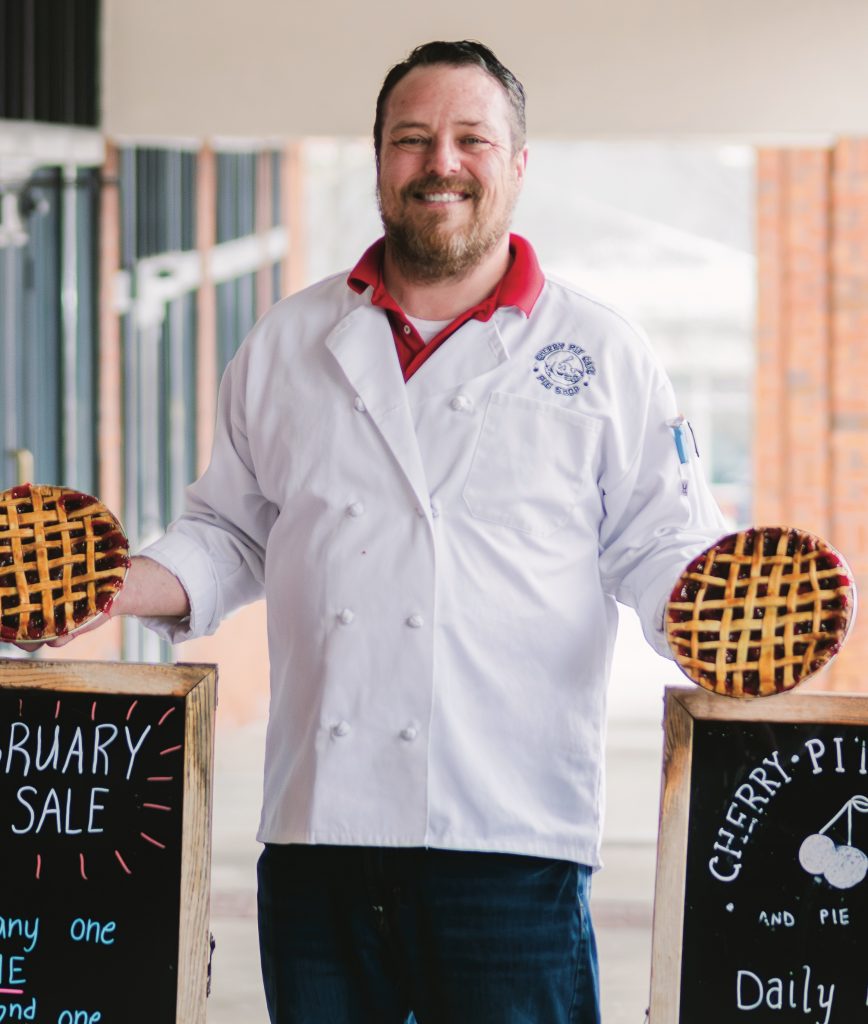
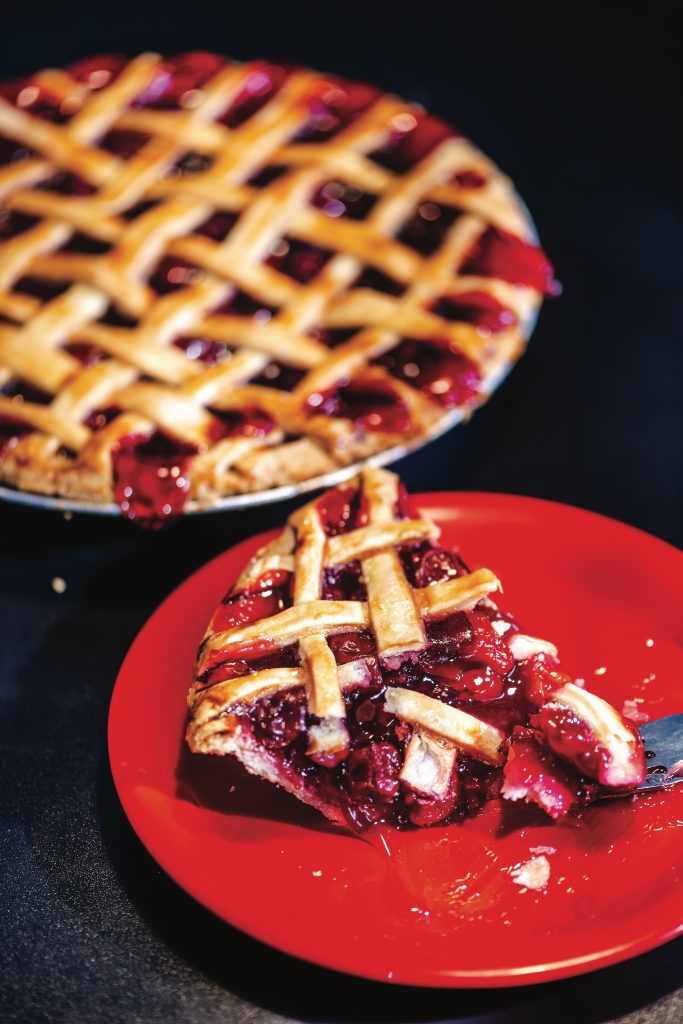
Walk into pie central and prepare to get a face full of pies and a friendly greeting from a waitstaff wearing cherry-red pie T-shirts. The walls are covered with pie slogans, pictures of pies and pie-making implements. And why not? Owner Brian Cotrone (along with his wife and business partner, April Douglas) estimates they have sold over 100,000 pies since opening July 1, 2013. The decor is cheery and modern, with bright-red upholstered banquettes and fast-casual service where your food is delivered to your table after you order at the counter.

OUR SLICE: Cherry lattice

THE LOWDOWN: This pie, made in-house from scratch like all their pies, is all about the filling, chock full of Michigan cherries. It is cooked in a steam kettle to assure the proper thickness and balance of sweet and sour. The homemade pie dough is latticed across the top, six vertical, six horizontal, and then coated with an egg wash to achieve a toasted-brown sheen.

MY TAKEAWAY: The cherries are the money in this pie, plump and piled high, with a gloriously gooey and addictive binding. The shell and the lattice are slightly sweet, balancing the tartness of the cherries. And since sour cherries are packed with melatonin and tryptophan, we’re totally convinced that cherry pie is good for you.

BEST SELLER: Pecan

THE PIE MAKERS: Twenty-five years ago, Brian, a corporate restaurant supervisor, and April, a restaurant general manager, met in Las Vegas. There, they ended up running a restaurant with a heavy pie focus. In July 2013, they launched their own pie-centric concept in Greensboro.

THE INSIDE SCOOP: Yes, they sell 10,000 pies a year, including a savory chicken pot pie, but The Cherry Pit Cafe also offers breakfast, lunch and dinner seven days a week for those of you who don’t think pie is a main course.

11 B Pisgah Church Rd, Greensboro
336-617-3249  |  cherrypitcafe.com

THE PIE HOLE: Dessert Du Jour

Catch Wendy Dodson and her Dessert Du Jour tent almost any Saturday it’s not raining or snowing along the back row of The Corner Farmers Market. The market, located at the corner of West Market and Kensington in the St. Andrew’s Episcopal Church parking lot, is open from 8 a.m. until noon Saturdays year round.

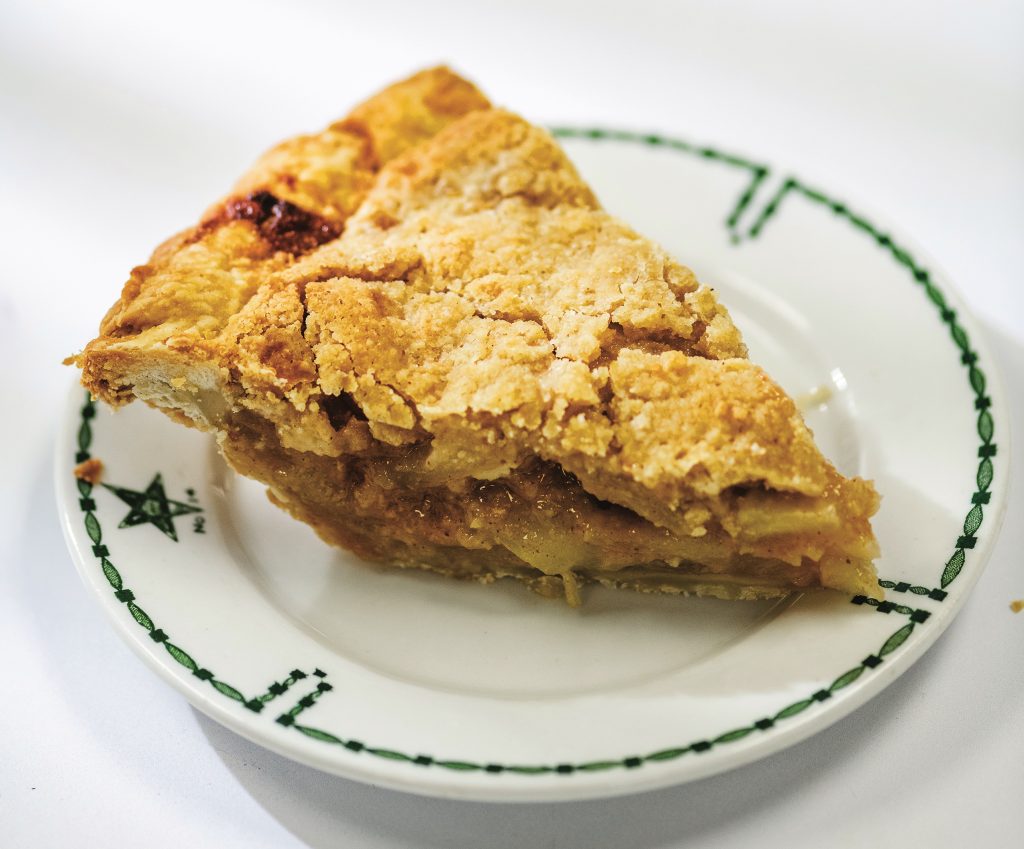
OUR SLICE: Apple crumb

THE LOWDOWN: Granny Smith apples are dusted with flour and sugar and then oven-roasted. Next? Brown sugar, spices and a whole stick — in bits — of butter. Once mixed and cooled, it goes into her handmade crust. Hand mixing the dough allows little globs of high-fat (Plugra) butter to melt and puff up during baking, similar to a croissant. Lastly, the crispy crumb layer, made of sugar, spices, flour and, you guessed it, more butter, tops it all.

MY TAKEAWAY: As my first bite, loaded with each layer — crust, apple filling and crumb — neared my own pie hole, my nose twitched, triggered by the smell of cinnamon-kissed apples and toasty, brown butter. Moist and tender, the caramelized apples are perfectly paired with the golden, flaky crust, resulting in a palate-pleasing balance of sweet and salty. And, for me, the cherry on top was the satisfying crunch of the golden crumb topping, of which, well, I left no crumbs.

BEST SELLER: Husband and O.Henry magazine founder Jim Dodson insists her chocolate chess pie is so decadent you’ll end up licking your fork clean.

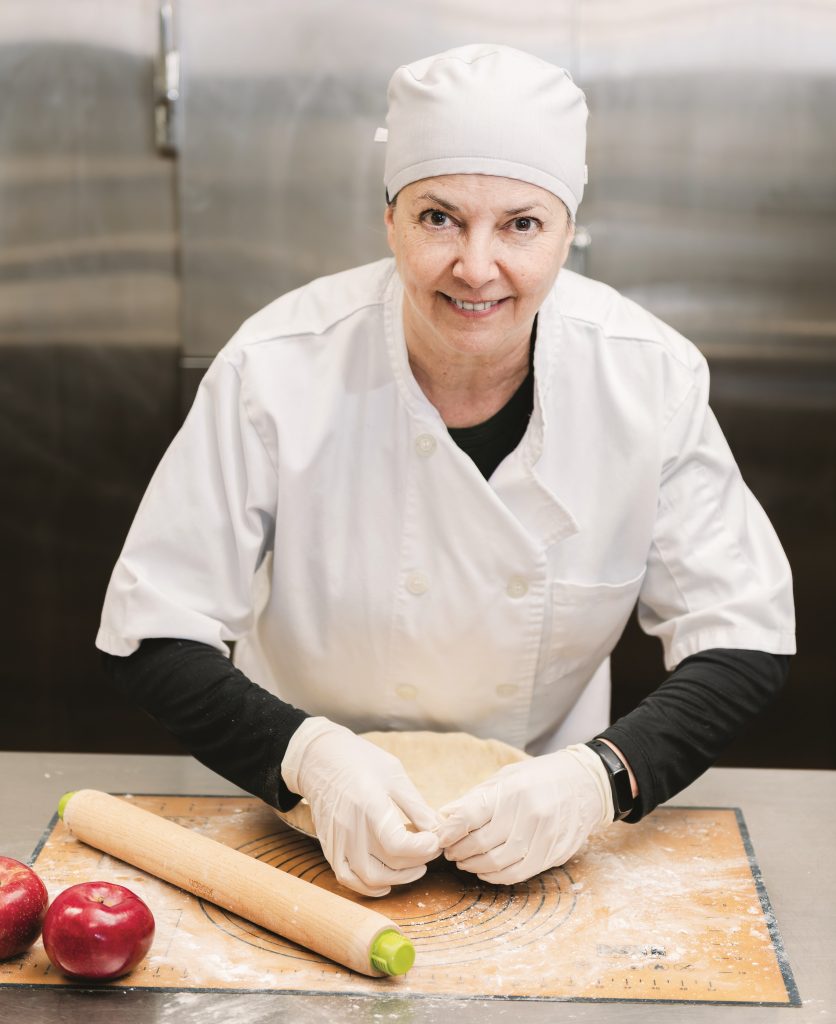
THE PIE MAKER: As a child, owner Wendy Dodson spent two weeks of every summer at her grandmother’s house. There, she learned the art of baking and making the perfect pie crust. Dessert Du Jour came into full fruition following COVID. Retiring from her HR job, Wendy put all her eggs into her baked-goods basket. Dessert Du Jour celebrates five years in business this month.

GOOD TO KNOW: Wendy offers market pre-orders so you can sleep in on a Saturday morning and rest assured that your pre-ordered pie, cookies or cake will be waiting for you until at least noon at the market.  OH

The Corner Farmers Market, 2105 W. Market St., Greensboro 910-585-2584  |  dessertdujour.net

Pleasures of Life

PLEASURES OF LIFE

Greensboro’s Perfect Pastry

The apple fritter at Donut World can love you back

By Brian Clarey

Gigi Williams knows exactly what she wants.

She breezes right through the front the door of Donut World’s Battlegrounds Avenue location, past dozens and dozens of donuts — twisted ones, rolled ones, the standard one-hole punch — and beelines to a particular spot in the long, glass case.

“May I have an apple fritter, please,” she says, gesturing to the dozen fritters behind the glass, arranged in a glistening grid on a parchment-papered baking tray.

“Make it two,” her partner jumps in, peering into the display cases. “And a cup of coffee.”

Behind the counter, Luz Martinez gathers the order. The couple hunches over their fritters at a corner table before a day of shopping. But the real reason they made the drive into Greensboro from Oak Ridge this morning is in their hands: It’s the fritter.

“I’m shopping,” Williams says, “but I can’t do it without this.”

After culinary school, she spent decades working in high-end kitchens around the country before settling in Oak Ridge with her partner. And of all the dishes she’s tried from kitchens all over the world, this simple one keeps her coming back.

“She started asking for an apple fritter yesterday,” her partner reveals.

Martinez confirms. Indeed, the apple fritter is the most popular item on the Donut World menu, which should come as no surprise to the thousands of Gate City residents who have already discovered it on their own or through the advice of a trusted palate. The day began with about 10 dozen of them; now, at the noon hour, she is halfway through her inventory.

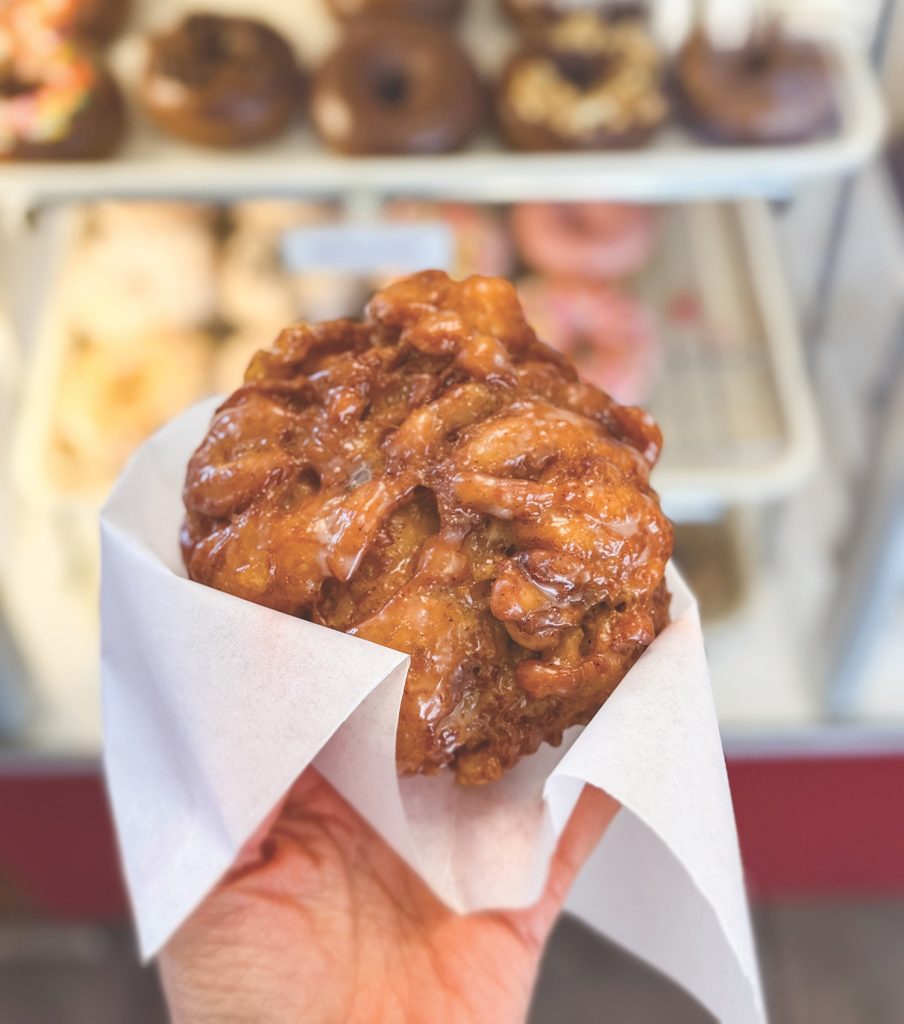
This apple fritter stands alone among the offerings at Donut World: cake and rise donuts, buttermilk bars, filled donuts, twisted donuts, little donut holes topped with glaze, Jimmies, crystalline sugar, fruity cereal, chopped peanuts, shaved coconut, crumbled Oreos and straight-up chocolate chips, all of which are uniformly excellent. But the fritter? It is a near-perfect example of the form, elegant in its simplicity, impeccably portioned, faultlessly prepared and highly accessible — you can get one in your hands at either the Battleground Avenue or West Market Street location for a couple of bucks.

There is nothing fancy about a fritter. It’s nothing but a bit of dough or batter, folded with an ingredient or two and then deep-fried. You can fritter just about anything, savory or sweet. There are corn fritters, blueberry fritters, conch fritters, pumpkin fritters, chicken fritters, banana fritters, cheese fritters, with variations around the globe. You could arguably label croquettes as a type of fritter, along with tempura and pakora.

The apple fritter is perhaps the lowest common denominator of fritter, available at every donut shop across the nation, in the packaged pastry section of the grocery, even inside the occasional vending machine.

But a first encounter with the Donut World apple fritter might leave the customer wondering if they had ever truly eaten a fritter before.

Its soft, light interior is encased in a toasty, brown bark formed when the crenellations in the dough succumb to the deep fry, its crunch intensified by a thin layer of glaze icing. The ratio of apple filling to dough is practically Fibonaccian — enough so that you get some in . . . almost . . . every bite, but not so much as to turn the whole thing into a mashed-up jelly donut.

“I just love pulling it apart,” says Williams, tearing into her fritter. “That first bite, you can tell it’s handmade, not machine-made.”

Shop owner Lean Ly brought the recipe with her when she and her family moved to Greensboro from San Luis Obispo, Calif. She comes from a long line of donut-makers — her family owns the Sunrise Donuts chain in Southern California — but she wasn’t thinking about donuts when she first got here. They came across the country for her husband’s job, and Ly wasn’t sure how she would contribute to the family finances. The answer quickly became clear.

“We did not see any family-owned donut shops in Greensboro like we had in California,” she says, “so I bring one into the area.”

The first shop, on West Market Street, is where the apple fritter began to make a name for itself in Greensboro. It quickly became the flagship store’s best-selling item.

The reason for the pastry’s popularity is simple as pie: “People love them very much,” she says.

The recipe is extraordinarily simple, with just three ingredients: dough (not batter), apple filling and cinnamon.

“You mix them together, you let them rise, fry until golden brown and then pour glaze all over them,” she says. Just like everywhere else. “The difference is the care and love we put into them.”

I suspect the “care and love” translates into the perfect fry time — just long enough to develop that magnificent, crunchy bark but not so long that the fritter becomes drenched with oil, first one side and then a practiced flip to brown the other.

“That’s just technique,” Ly says. “When you do something for so long and with so much love, you know exactly how long to fry them, and exactly when to spin them.”

Back in the donut shop, Williams has finished her apple fritter and is ready to begin her shopping. But before she does, she has a request on this day for a reporter working the pastry beat.

“Please,” she says, “do not share this secret. Not everyone needs to know. I want to be able to get my fritters.”

Sorry, GiGi — that’s not how we do things around here. Something this delectable needs to be shared.

Poem March 2026

Poem

Poem

Julian

In christening gown and bonnet,

he is white and stoic as the moon,

unflinching as the sun burns

through yellow puffs of pine

pollen gathered at his crown

while I pour onto his forehead

from a tiny blue Chinese rice cup

holy water blessed

by John Paul II himself

and say, “I baptize you, Julian Joseph,

in the name of the Father, and of the Son,

and of the Holy Spirit.”

Nor does he stir when the monarchs

and swallowtails,

in ecclesiastical vestments,

lift from the purple brushes

of the butterfly bush

and light upon him.

  — Joseph Bathanti

Simple Life

SIMPLE LIFE

My March Awakening

Finding the Kingdom of God in my own backyard

By Jim Dodson

Every year as March returns and my garden springs to life, I think of the remarkable woman who changed my life.

Her name was Celetta Randolph Jones, “Randy” for short, a beloved figure in the city of Atlanta’s business, arts and philanthropic circles. Five years my senior and leagues ahead of me in terms of spiritual growth, Randy was introduced to me by my editor, Andrew Sparks, during my first week on the Atlanta Journal-Constitution Sunday Magazine staff.

At that time in the spring of 1977, Randy was running The Georgia Trust for Historic Preservation and had stopped by the magazine to introduce herself and plumb my interest in historic preservation.

“Something tells me you two are bound to become best friends,” Andy wryly observed, a prophetic remark if there ever was one. 

In short order, Randy became my best friend and confidant, the one person I felt comfortable with discussing matters of life and death, heart and soul. Our love affair was a case of what the ancients called agape, transcending romance and superficial attraction. Besides, Randy was secretly dating an Episcopal priest, which I kidded her about relentlessly. She loved to give the needle back about the young women I went out with in those seven years of our deepening friendship.

Though she never married, “Aunt Randy” was the godmother of half a dozen of her nieces and nephews and, eventually, my own daughter, Maggie.

During my first few years in the so-called “city too busy to hate,” I frequently wrote about the darker side of the booming New South — race violence, corrupt politicians, unrepentant Klansmen, the missing and murdered, and young people who flocked to the city seeking fame and fortune only to lose their way and sometimes their lives.

A life-changing moment came one Saturday night when I was waiting for a squad from the city morgue to pick me up for a story I was working on about Atlanta’s famed medical examiner. As I stood in my darkened backyard waiting for my dog, McGee, to do her business, I witnessed my next-door neighbor, an Emory University med student, being gunned down in an alleged drug hit. He died as we waited for the ambulance to arrive.

Not surprisingly it was Randy who helped me make sense of this. The morning after my neighbor’s murder, I’d opened my Bible to the Book of Matthew for the first time in years and was struck by a reference that Jesus repeatedly makes about the “Kingdom of Heaven.”  That evening at dinner, I grumbled, “So where the hell on Earth is the so-called Kingdom of Heaven?”

Randy simply smiled. “It’s already here, my love. Inside us. You just have to see it.”

I was a wee bit annoyed by her calm assurance.

Randy was a classy and calm Presbyterian with an unshakable faith in God’s grace. I was a backslid Episcopalian who hadn’t darkened a church doorway since the murder of my girlfriend during our college days.

Purely because of Randy, however, I attended services the next Sunday at historic All Saints’ Episcopal in downtown Atlanta — a place where the doors were always open to the homeless. I soon took a job writing about the suffering of the Third World for the Presiding Bishop’s Fund for World Relief, and even made a vow that, going forward, I would only write about subjects and people who had a positive impact on life. Randy Jones was my inspiration.

I lived up to that vow, and even briefly entertained taking myself off to the Episcopal Seminary until a crusty old bishop from Alabama suggested that I could “probably serve the Lord much better by writing than preaching.”

My pal Randy gave her famous, sultry laugh when I mentioned his somewhat frank comment — and she agreed with him.

During my final years in Atlanta, Randy and I met at least once a week for lunch or dinner to talk about the events of the day and the mysteries of this world. She also spent several Christmases with my family in North Carolina, attended both of my marriages, visited my young brood in Maine and joined us for a joyous spring vacation at our favorite Georgia beach.

In many ways, she became the Dodson family godmother and probably the closest I’ll ever come to knowing a living saint — though she would respond with her sultry laugh at such a silly notion.

Over the decades, as Southern springtime returned, wherever I happened to be in the world, Randy would track me down by phone. She’d finish our talk with a couple meaningful questions: So, Jim, are we any closer to the Kingdom of Heaven? And . . . How is your beautiful garden growing?

She and I had visited public gardens together many times. Randy hailed from Thomasville, a small South Georgia town known as “City of Roses,” and knew that once I’d swapped big-city life for small-town living, I’d become a committed man of the Earth like my rural kin before me. There was no going back, she knew, on gardening or faith.

As my spiritual life grew and deepened across the years, I’d come to believe the Kingdom of Heaven might indeed be nearby. It’s no coincidence that Jesus mentions it 32 times in the Book of Matthew. His partner, Luke, simply calls it the “Kingdom of God” and makes clear — as Randy did — that it “lies within” everyone.

My favorite reference comes from the Gospel of Thomas, when Jesus’ followers pester him to explain where the “Kingdom” exists:

Jesus said, “If those who lead you say to you, ‘See, the kingdom is in the sky,’ then the birds of the sky will precede you. If they say to you, ‘It is in the sea,’ then the fish will precede you. Rather, the kingdom is inside of you, and it is outside of you.

Wherever it exists, I have my late friend, Randy Jones, to thank for putting me on a winding path to the Kingdom within. 

And I’m not alone.

Randy Jones passed away peacefully in October 2022. Her funeral service at Atlanta’s First Presbyterian Church was packed with people whose lives Randy had touched, from business leaders to artists, from church members to childhood friends, including a half a dozen godchildren and yours truly. The sanctuary overflowed with stories of her generosity and quiet wisdom, each person recalling how Randy’s kindness had shaped their own journeys. The service was a testament to the wide effect she had not only in Atlanta but in the hearts of everyone fortunate enough to know her.

Including a former backslid Episcopalian.

Omnivorous Reader

OMNIVOROUS READER

The Theft That Wasn’t

The tale of the lost and found Picasso

By Anne Blythe

Most of us have heard that old cliché “Kids say the darnedest things,” but few of us could imagine getting the kind of phone call that Whitcomb Mercer Rummel Sr. received in March 1969 from his eldest child. There was nothing cliché or cutesy about it.

“Hey, Dad, I accidentally stole a Picasso,” Bill Rummel said to his father nearly 57 years ago. What happened afterward is a bit of creative skullduggery that has been concealed in the annals of one family’s history far longer than one of the key participants would have liked.

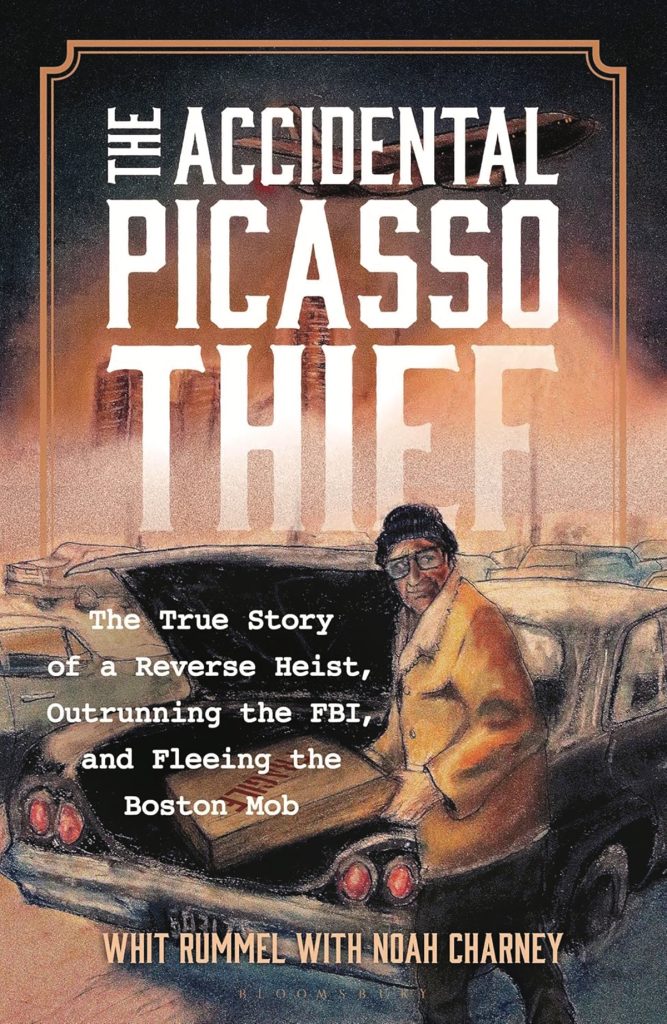
Whit Rummel Jr., a filmmaker who lives in Chapel Hill, and Noah Charney, an American art historian and fiction writer based in Slovenia, have written The Accidental Picasso Thief: The True Story of a Reverse Heist, Outrunning the FBI and Fleeing the Boston Mob to share that story with the rest of the world.

Disclosure: I have known Whit Rummel, the author, for many years, relishing in his stories and adventures. Although I’ve heard bits and pieces of this story before, this is the first time I’ve been able to soak it all in.

As Whit Rummel, the only surviving member of the trio that pulled off the so-called “reverse heist” writes, the book — part memoir, part true crime — “is the story of one of the oddest art crimes in American history.”

It’s a tale Rummel has wanted to share in full for decades but couldn’t — for reasons ranging from fear of the famous mobster Whitey Bulger, to respect for a brother’s wishes and a dogged hunt for the location of the painting. In June 2023 The New York Times ran a story titled “Hey Dad, Can You Help Me Return the Picasso I Stole?” but Rummel had more to say.

It begins in 1969. Whit Sr. was an empty-nester with his wife in Waterville, Maine. He was the owner of a popular restaurant near Interstate 95 and an ice cream store with in-house creamery serving up unique and enticing flavors like Icky Orgy.

Bill Rummel was in his mid-20s at the time, working as a forklift operator at Logan Airport in Boston moving crates around the world for Emery Air Freight. A historic snowstorm hit the East Coast, leaving chaos in its wake. As flights were delayed and diverted, Bill loaded several flats into the trunk of his car from pesky “orphan” piles clogging up the outbound area. Wrapped up in one of those flats was a Pablo Picasso original, Portrait of a Woman and a Musketeer, that was en route from Paris to a gallery owner in Milwaukee.

Unlike his younger brother, Whitcomb Mercer Jr., Bill wasn’t particularly interested nor appreciative of art and didn’t realize a valuable painting was in his possession. When he found out what he’d inadvertently done, he called his brother, a passionate art lover, who was at Tulane University at the time. After several phone calls, Bill and Whit decided it was time to call their dad, a man they called “the fixer.”

Whit Sr. and his wife, Ann, had moved to Maine in the ’50s and raised their sons there. The boys had a mischievous streak in them, perhaps inherited from a father who relished taking them on “wild goose chases.”

Whit and Bill, now in young adulthood, needed their father’s guidance. What should they do with the stolen Picasso? This was no wild goose chase. They had heard the FBI was on the hunt for the painting. To make matters worse, rumor was that Whitey Bulger’s notorious Winter Hill Gang also was searching for it, threatening anyone trying to move in on their airport turf.

“Our father, after all, was the grand fixer. The one guy who’d always been there for us, pulling us out of whatever kind of jam we’d found ourselves in (and there had been many),” Whit writes. Their dad reeled off several options. One was keep the painting, bury it under the floor of the Waterville restaurant and uncover it some years later, feigning shock and surprise. The other option? “He said maybe there was a way to return it. Without letting anybody know who took it,” Bill told his brother.

That’s the option they chose. Whit Jr. got instructions from his dad. “I want you to write a brief note to accompany the return of the painting,” his dad said. “Nothing long or complex. Just a few mysterious sentences to put them off the track of someone like Bill.”

To this day, Whit chuckles at the note he composed with intentional “grammatical quirks.”

PLEASE ACCEPT THIS TO
REPLACE IN PART SOME OF THE PAINTINGS REMOVED FROM MUSEUMS ACROSS THE COUNTRY. —  ROBBIN’ HOOD.

Whit Sr. and Bill would don costumes, fake mustaches and fedoras, get in a Chevy Impala and set off to return the Picasso at the Boston Museum of Fine Arts. An unexpected sighting of an employee near the loading dock upset their plans, but eventually the painting made it to the museum. A blurb announcing its return was in the news, and the Rummels went on with their lives, though their dad would die suddenly just a few years later, in 1972.

As the years went by Whit wanted to make a movie about the unwitting theft, but his brother wanted it to remain a secret, though Bill did do an interview about the incident with This American Life that never aired. He passed away in 2015.

There are some differences in the version Bill told then and what Whit remembers from their phone calls when his brother first told him he had “a friggin’ Picasso.” In the book, Whit shares both versions of how his brother recounted coming into possession of the crate. Though Whit never accuses his brother of knowingly taking the painting, he acknowledges there could be doubts about his intentions.

The book details the surviving Rummel brother’s search for the painting now and his hope to one day have his picture taken in front of it with his son, another Whit Rummel, and a nephew who shares their name, too. If that were to happen, the three — named for “the fixer” — would be “smiling proudly and loudly now, because our story has finally been told.”

For anybody who cares about art, the creation of it, and the quirkiness that makes families special, it’s a story worth telling, reading and even telling again.